Hidden Pair
beginnerWhen two cells in a Region contain the same two digits, and those digits don’t appear in any other cell in the Region, this is called a Hidden Pair. The two cells must contain only those digits, and any other candidates in these cells can be eliminated.
A Hidden Pair occurs when two specific digits appear as candidates in exactly two cells within a single region (row, column, box, diagonal or jigsaw block), but these cells also contain additional candidates. Importantly, no other cells in that region can accommodate either of these two digits. As a result, the additional candidates in these two cells can be safely eliminated, leaving only the two digits of the Hidden Pair as the valid options for those cells.
Example 1
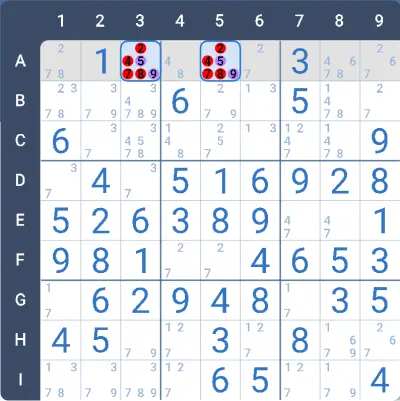
Examine the image below. In the shaded Row A, digits 5 and 9 in cells A3 and A5 form a Hidden Pair.
These are the only cells in the region that can contain the digits 5 and 9. Consequently, the remaining candidates in these cells (highlighted in red) can be eliminated.
Example 2
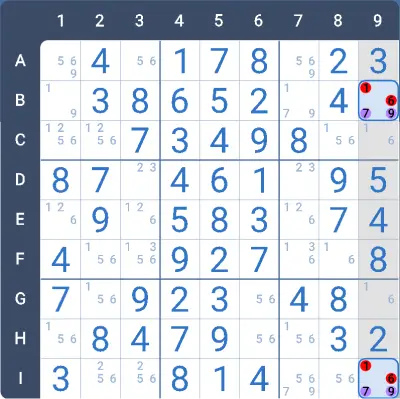
Examine the image below. In the shaded Column 9, digits 7 and 9 in cells B9 and I9 form a Hidden Pair.
These are the only cells in the region that can contain the digits 7 and 9. Consequently, the remaining candidates in these cells (highlighted in red) can be eliminated.
Example 3
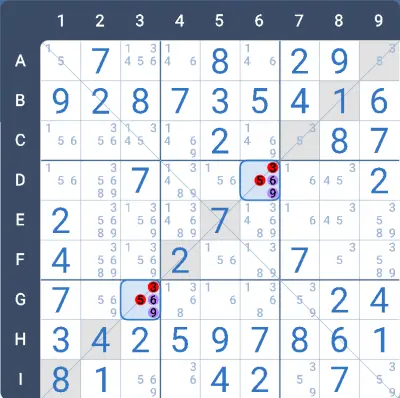
In the image below, the board follows classic Sudoku rules with an additional diagonal constraint.
In diagonal boards, the two main diagonals must contain each digit from 1 to 9 exactly once, making each diagonal a region.
In the shaded diagonal, digits 6 and 9 in cells D6 and G3 form a Hidden Pair. These are the only cells on the diagonal that can hold the digits 6 and 9. Therefore, the remaining candidates in these two cells can be eliminated.
Practise this strategy with built-in step-by-step hints inside our apps.