Naked Pair
beginnerTwo cells that see each other and contain only two possible digits are called Naked Pair. These digits can be eliminated from other cells that see both of these cells.
When two cells see each other and have only two identical digits as candidates, the digits are called a Naked Pair. We can eliminate all occurrences of these digits from cells that see both of the Naked Pair cells. In classic Sudoku, both cells of the Naked Pair are in the same Region (same row, column, or box), and all the cells that see the Naked Pair cells must be in the same Region.
See: Two cells are seeing each other if the rules prevent them from having the same digit.
Example 1
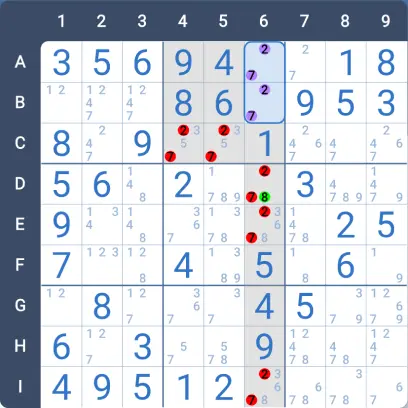
Examine the image below. Cells A6 and B6 are a Naked Pair. They can have exactly the same two digits: 2 and 7. Every other cell in Box 2 (the shaded top middle 9 cells) sees A6 and B6, therefore 2 and 7 can be eliminated from C4 and C5. Similarly, all the other cells in column 6 see A6 and B6, therefore 2 and 7 can be eliminated from D6, E6, and I6.
Example 2
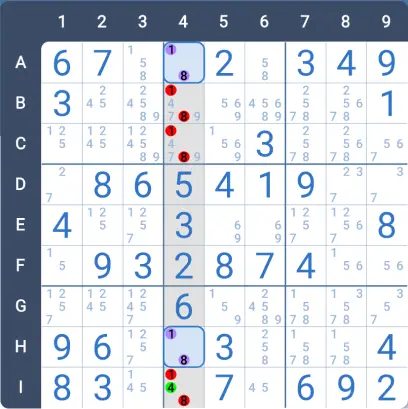
In the image below, 1 and 8 are a Naked Pair in cells A4 and H4. The digits 1 and 8 can be eliminated from the other cells of column 4.
Example 3
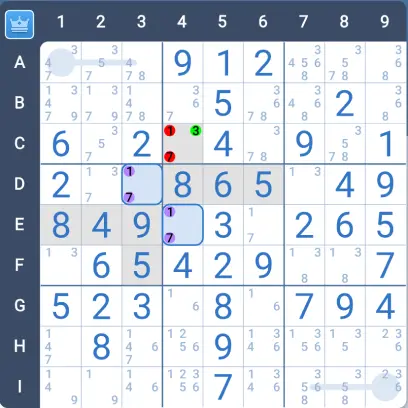
This is an interesting example. At first sight, it might seem like a bad example. The following board has three variants: Classic Sudoku, Thermo, and Chess King. Chess King rules state that the eight surrounding cells of a digit cannot have the same digit. The Thermo rules are not relevant in this example. In the image below, D3 and E4 form a Naked Pair; both can have only the digits 1 and 7, and they see each other because of Chess King rules. It means that if one cell is 1, the other must be 7 and vice versa.
Cell C4 sees both E4 and D3. It sees E4 because of Classic Sudoku rules and it sees D3 because of Chess King rules. Therefore, C4 cannot have the digits 1 or 7.
Practise this strategy with built-in step-by-step hints inside our apps.