Locked Set
mediumWhen a group of cells contains the same digit, and one of them must be that digit, it’s called Locked Set. The digit can be eliminated from any cell that ‘sees’ all the Locked Set cells.
A digit is Locked into a Set of cells when it can only be placed into one of those cells in that Region. The set of cells is called a Locked Set for that digit in that Region.
All other appearances of the digit that see all the cells of the Locked Set can be eliminated.
Example 1
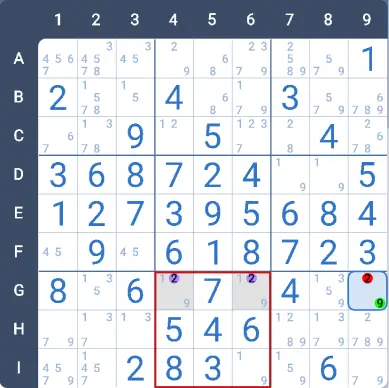
In the image below, the 2’s in the red-framed box form a Locked Set. The 2 must be in either G4 or G6. The rest of Row G sees both of these cells, so each appearance of 2 in Row G that is not part of the Locked Set can be eliminated. The only appearance of 2 outside the Locked Set in Row G is in G9, and it can be eliminated.
Example 2
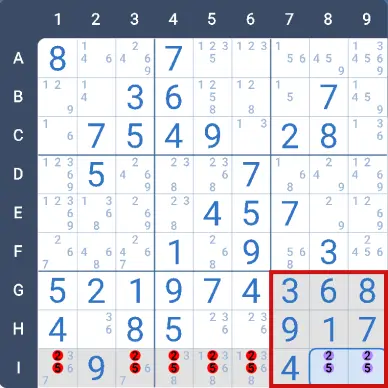
In the image below, the 2’s and 5’s in the red-framed box form a Locked Set. The 2 and 5 must be in either I8 or I9. The rest of Row I sees both of these cells, so each appearance of 2 and 5 in Row I that is not part of the Locked Set can be eliminated. All the red-highlighted appearances of 2’s and 5’s in Row I can be eliminated. This strategy, where two digits can only be placed in two cells in a region, is also called a Naked Pair, which will be covered in the ‘Naked Pair’ strategy. By extension, every Naked Triple or Naked Quadruple is also a Locked Set.
Example 3
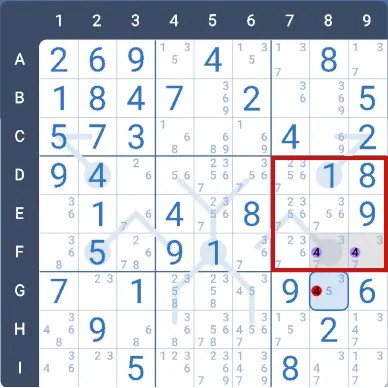
In the image below, the board includes not only Classic Sudoku but also Thermo and Chess King variants. The elimination is a bit different and takes into account the Chess King rules. The purple-highlighted 4’s in the red-framed box form a Locked Set. Here, there are no additional 4’s in either the framed box or Row F. However, according to the Chess King rules, the 4 in G7 (highlighted in red) sees both of the purple-highlighted 4’s and can be eliminated.
Practise this strategy with built-in step-by-step hints inside our apps.