Candidate Restrictions
mediumCandidate Restrictions happen when the candidates of a cell limit the possible candidates in other cell(s). For example, in a Non-consecutive puzzle, if a cell’s candidates are only 1 and 3, the cells directly above, below, left, or right cannot contain the digit 2, as it would create consecutive digits.
Candidate Restrictions
Sometimes, a possible digit (called a candidate) in one cell limits what digits can go in a neighboring cell. This is known as a Candidate Restriction.
For example, in a Non-consecutive puzzle, if a cell can only be 1 or 3, then the digits 2 cannot appear in any cell directly next to it — since 2 is consecutive to both 1 and 3, which would break the rule.
Level: Medium
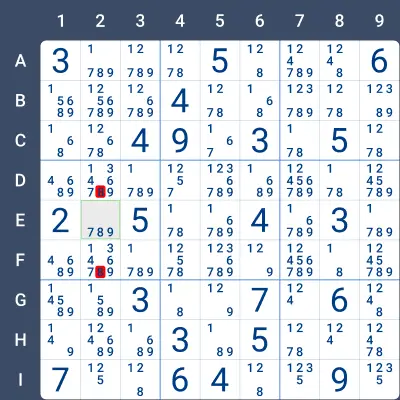
Example 1: Non-consecutive + Classic Sudoku
The variants in play are Classic Sudoku and Non-consecutive.
The candidates in the shaded cell E2 affect the possibilities in F2 and D2.
Elimination:
Remove 8 from the candidates in F2 and D2.
Why:
- If E2 = 8, then F2 ≠ 8 and D2 ≠ 8 (Classic rule: no repeats in a row).
- If E2 = 7 or E2 = 9, then F2 and D2 also can’t be 8, since 8 is consecutive to both 7 and 9 (Non-consecutive rule).
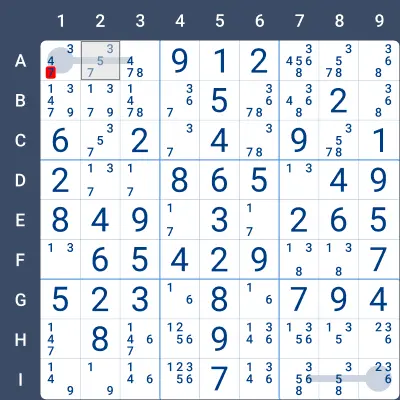
Example 2: Thermo + Classic Sudoku
The variants in play are Classic Sudoku and Thermo.
The candidates in the shaded cell A2 limit what can go in A1, which is earlier on the same thermo.
Elimination:
Remove 7 from the candidates in A1.
Why:
- A2 comes after A1 on a thermo line, so it must be a higher number.
- The biggest digit A2 could be is 7, so A1 must be less than that.
- If A1 = 7, then there’s no legal digit left for A2, breaking the Thermo rule.
Practise this strategy with built-in step-by-step hints inside our apps.