Ascending Sequences Sudoku
A row should contain the same number of ascending digit sequences as the number to its left, while a column should have the same number of ascending digit sequences as the number above it. An ascending sequences refers to a sequence of cells with numbers that increase from left to right in a row, or from top to bottom in a column.
Ascending Sequences is a challenging variant created by Logic Wiz. Puzzles featuring the Ascending Sequences variant display numbers to the left of the rows and above the columns. An ascending sequences refers to a sequence of cells with numbers that increase from left to right in a row, or from top to bottom in a column.
Ascending Sequences rule: A row should contain the same number of ascending digit sequences as the number to its left, while a column should have the same number of ascending digit sequences as the number above it.
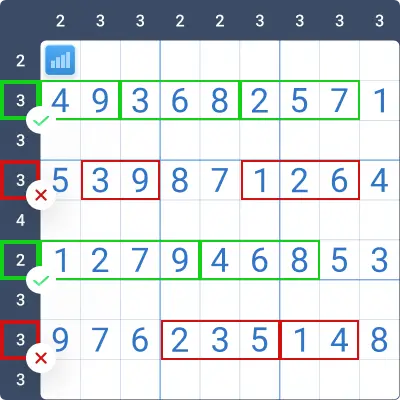
Few Guidelines:
- A sequence is always longer than a single digit.
- The digits to the left of the rows and above the columns refer to the number of Sequences.
- An Ascending Sequence means a series of digits arranged in ascending order. In a row, the smallest digit in the sequence is on the left, and the largest is on the right. In a column, the smallest digit is at the top, and the largest is at the bottom.
- The digits in a sequence don’t have to be consecutive, but they can be.
Tips:
- Apply the “What if” logic: Check how many sequences the row or column might have if a certain cell contains digit ‘x’.
- A smaller digit following a larger digit always starts a new sequence unless it is in the last cell of the row or column.
- Focus on the digits 1, 2, 8, and 9:
- 1 always starts a sequence unless it is the last digit in a row or column.
- 9 always ends a sequence unless it is the first digit in a row or column.
- The same logic applies to 2 and 8, except when 2 follows 1 and 8 precedes 9.
Play Ascending Sequences Sudoku in our apps: