Pulse Sudoku
Orthogonal neighbours of a pulse cell must contain a digit that is adjacent to, a multiple of, or a divisor of the pulse digit. Neither pulse cells nor their orthogonal neighbours may contain the digit 1.
Pulse is a brain-twisting variant created by Logic Wiz. Some cells on the board are marked with the special Pulse symbol - and when a cell pulses, it sends a wave rippling through its neighbours!
The value of a Pulse cell determines the “wavelength” of the four orthogonally adjacent cells around it.⚡
🧠 The Pulse Rule
Orthogonal neighbours of a pulse cell must contain a digit that is adjacent to, a multiple of, or a divisor of the pulse digit. Neither pulse cells nor their orthogonal neighbours may contain the digit 1.
Example — Pulse digit: 4
If a pulse cell contains 4, its four orthogonal neighbours must each be one of the following:
- Adjacent (±1): 3 or 5
- Multiples of 4: 8
- Divisors of 4: 2
So the only digits that can surround a 4 pulse cell are: 2, 3, 5, and 8.
More examples below:
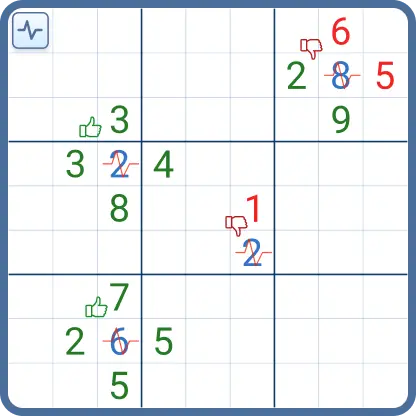
💡 Pulse Tips
Tip 1 — The digit 1 is a ghost 👻
The digit 1 can never be a pulse cell or neighbour one - it’s completely isolated from the pulse network. Spotting a 1 near a pulse cell is an instant contradiction, and knowing where 1 can’t go is powerful deduction fuel!
Tip 2 — The lonely digits: 5, 7 & 9
These digits are deceptively restrictive as pulse cells — each one has only two valid neighbours:
- 5 → can only be surrounded by 4 or 6
- 7 → can only be surrounded by 6 or 8
- 9 → can only be surrounded by 3 or 8
The deduction: if a pulse cell has 3 or more orthogonal neighbours that all see each other, the pulse digit cannot be 5, 7, or 9.
Play Pulse Sudoku in our apps: