Skyscraper Sudoku
The numbers around the edges of the grid indicate how many skyscrapers are visible from that vantage point. Taller skyscrapers block the view of shorter ones. Larger digit means a taller skyscraper.
In Skyscraper puzzles, you’ll find numbers placed around the grid—on the left, right, above, and/or below. These numbers serve as clues, indicating how many skyscrapers are visible from that specific vantage point.
In this context, the size of the digit holds significance: a greater digit represents a taller skyscraper. Moreover, a taller skyscraper obstructs the view of shorter ones that appear after it from the given vantage point. The objective is to use these clues and the rules to correctly position the skyscrapers within the grid.
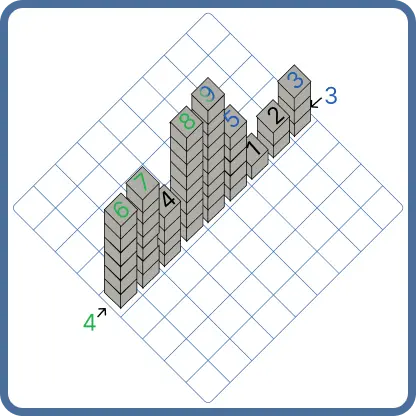
In the image above, take note of the green number 4 on the left side of the grid. This number signifies that 4 skyscrapers are visible from the 4 vantage point. Specifically, these skyscrapers are 6, 7, 8, and 9. Notably, the black 4 is obscured by the presence of the 6 and 7 on its left, while the black 1 and 2 remain hidden due to the presence of all the skyscrapers to their left. Additionally, the blue 3 is concealed by the taller skyscrapers situated on its left.
On the right side, observe the blue number 3. This indicates that 3 skyscrapers are visible from the 3 vantage point—namely, 3, 5, and 9. Interestingly, the 1 and 2 are hidden by the 3 (from the 3 vantage point), and the 9 effectively conceals all the skyscrapers that come after it from that particular vantage point.
Skyscraper rule: The numbers around the edges of the grid indicate how many skyscrapers are visible from that vantage point. Taller skyscrapers block the view of shorter ones. Larger digit means a taller skyscraper.
See the image below for examples.
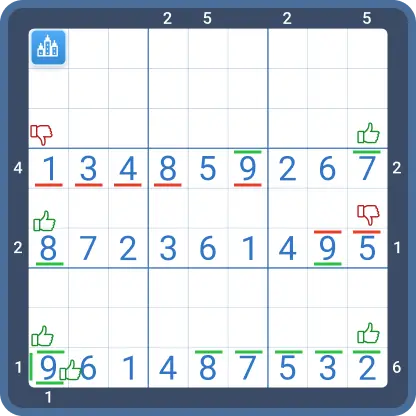
In Row D, the number on the left is 4, yet there are 5 visible skyscrapers from that vantage point: 1, 3, 4, 8, and 9. Therefore, this solution is incorrect.
However, in Row D, the number on the right side is 2, and indeed, there are 2 visible skyscrapers from this vantage point—7 and 9. All other skyscrapers in the row are hidden by either the 7 or the 9.
Moving to Row F, the number on the left side is 2, and appropriately, there are only 2 visible skyscrapers: 8 and 9. The remaining skyscrapers are concealed by the 8 and the 9.
On the right side of Row F, the number is 1, but there are actually 2 visible skyscrapers: 5 and 9. The other skyscrapers are hidden by the 9.
Can you figure out why both sides of Row I are correct?
Skyscraper Tips
- The number 1 outside the grid suggests that the digit next to the 1 must be 9, effectively concealing the rest of the skyscrapers.
- The number 9 outside of the grid implies that all the digits must be in order, from 1 to 9.
- Unless the number outside the grid is 1, 9 cannot be in the first cell of the row or column.
- When approaching the puzzle, start by focusing on tall skyscrapers, as they indicate that the higher numbers are likely close to the end of the row or column.
- Consider using highlight markers to mark cells where 7, 8, and 9 cannot go, providing additional clarity in the solving process.
- Using the drawing tool to depict ‘<’ and ‘>’ between cells can be beneficial, indicating the relationship and order between them.
Play Skyscraper Sudoku in our apps: