Arrow
variantThe Arrow variant offers a range of strategies, each with varying levels of complexity.
The Arrow variant offers a range of strategies, each with varying levels of complexity.
These strategies include:
- Analyzing the possible sums for an arrow.
- Evaluating the potential digits for an arrow based on its sum and the candidates along its path.
- Eliminating possibilities outside the arrow when a specific digit must be placed on it.
- Considering the interaction between the digits of multiple arrows, especially when their cells intersect.
Arrow Tips:
- The minimum sum for an arrow with a 2-cell shaft, where the cells see each other, is 3 (1 + 2).
- The minimum sum for an arrow with a 3-cell shaft, where the cells see each other, is 6 (1 + 2 + 3).
- Any arrow with a shaft length of 3 cells, where the cells see each other, must contain two of the digits (1, 2, 3).
- The only 3-cell arrow combination, where the cells see each other, that does not include the digit 1, is (2, 3, 4).
Arrow Strategies
1. CompleteLastDigit
Level: Simple
When all but one digit on the arrow are filled, the value of the remaining digit can be easily calculated with simple math
Example:
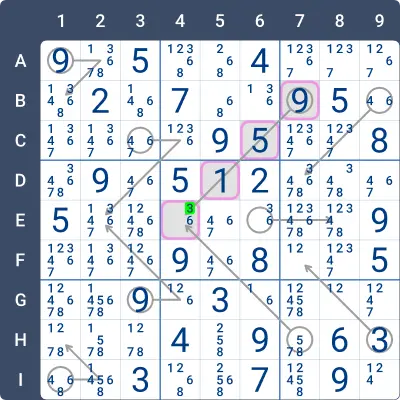
Refer to the image below. The highlighted arrow has a sum of 9. Two digits on the arrow are already known: 5 and 1. With only one cell remaining, the value of this cell must be calculated as follows: (9 - 5 - 1 = 3). Therefore, E4 = 3.
2. MinValue
Level: Medium
Considering the arrow’s length, the possible candidates or numbers in some cells, and the relationships between the cells, we can determine the minimum value of the cells along the arrow.
Example:
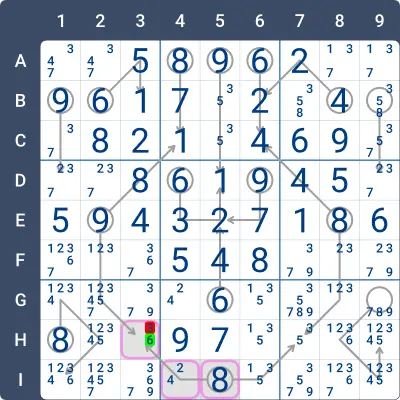
The sum of the highlighted arrow in the image below is 8. Cell I4 has only 2 and 4 as possible candidates. If H4 were 3, the maximum possible sum of the arrow would be (3 + 4 = 7), which is less than the required sum of 8. Therefore, the minimum value for H3 to achieve the arrow sum is 4. Consequently, 3 can be eliminated from H3.
3. MaxValue
Level: Medium
Considering the arrow’s length, the possible candidates or numbers in some cells, and the relationships between the cells, we can determine the maximum value of the cells along the arrow.
Example:
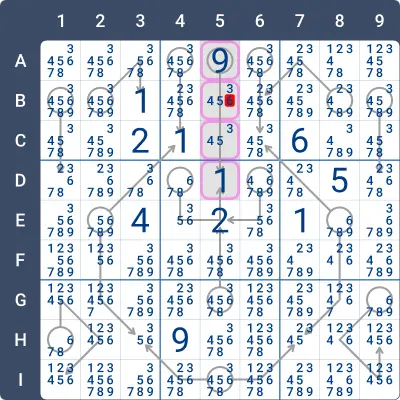
Refer to the highlighted arrow in the image below. The sum of the arrow is 9, and D5 = 1. The candidates in C5 are 3, 4, and 5. If B5 were 6 or greater, the total sum of the arrow would be at least 1 (D5) + 3 (minimum of C5) + 6 = 10, which exceeds the arrow sum. Therefore, the largest possible candidate for B5 is 5, and 6 can be eliminated from B5.
4. MinMaxSum
Level: Advanced
Considering the length of the arrow, the possible candidates in each cell, and the relationships between the cells, we can determine both the minimum and maximum sum of the arrow.
- Arrow sum minimum: This is the sum of the lowest candidates in the cells along the arrow.
- Arrow sum maximum: This is the sum of the highest candidates in the cells along the arrow.
Note: If cells along the arrow see each other, this must be taken into account when determining the lowest and highest candidates for each cell.
Example:
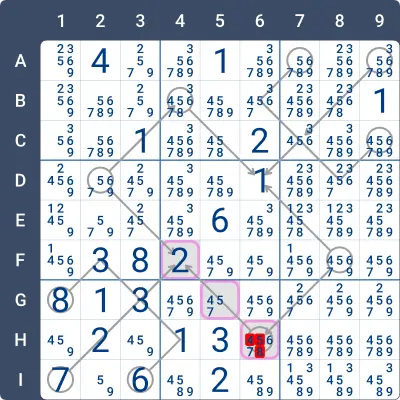
Look at the highlighted arrow in the image below. F2 = 2, and the candidates for G4 are 4, 5, and 7.
- G5 ≠ 7 because 9 is not a valid option for the arrow sum.
- Arrow sum minimum: 2 + 4 = 6.
- Arrow sum maximum: 2 + 5 = 7.
Therefore, 4, 5, and 8 can be eliminated from H6.
5. LockedSet
Level: Advanced
From the sum or possible sums of an arrow, we can determine that digit X must appear in one or more cells of the arrow. As a result, digit X can be eliminated from any cells that see all the cells where X can go.
Example:
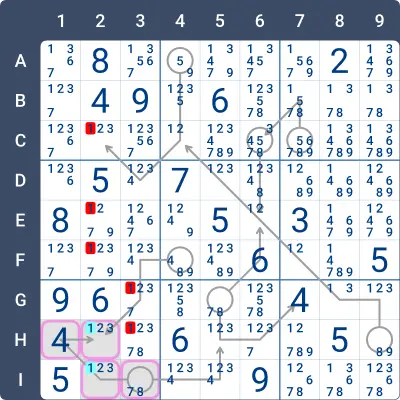
Refer to the highlighted arrow in the image below. It is a 3-cell shaft arrow where all three cells ““see”” each other, with a possible sum of either 7 or 8.
Every 3-cell shaft arrow that ““sees”” each other must include the digit 1. The possible combinations for the sums are:
- 7 = (4, 2, 1)
- 8 = (5, 2, 1)
- 8 = (4, 3, 1)
The digit 1 on the arrow shaft must be placed in either H2 or I2. Consequently, you can eliminate 1 from all cells that ““see”” both H2 and I2. These 1’s are highlighted in red in the image.
6. CombinationsExclusion
By looking at the possible values for the arrow sum, the base, and the candidates along the shaft, you can often eliminate impossible digits from certain cells on the arrow.
Example:
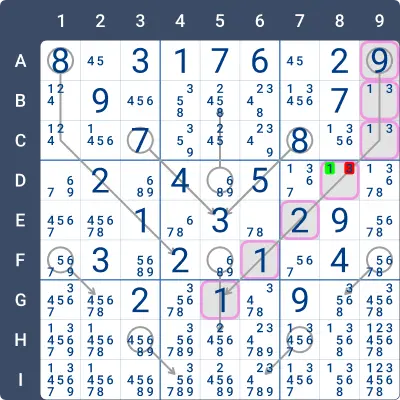
Look at the highlighted arrow in the image below. The sum of the arrow is 9. It is a six cells shaft arrow, there cells along the arrow are already solved and sum up to 4. B9 and C9 must be the pair 1 and 3. There is only one option remaining for the digit 9-4-1-3 = 1. Therefore, D8=1
7. MultipleArrows
Level: Advanced
Sometimes, exploring a single arrow is not sufficient for making decisions or eliminations. In such cases, a broader perspective, considering the possible combinations of multiple arrows, becomes necessary. This strategy focuses on arrows that either start or end in the same Region. The strategy is best explained through examples, as each situation demands a different analysis depending on the arrows, restrictions, and board variants. The goal of this example is to present several approaches that can be applied to similar situations.
Example 1
We are focusing on arrows that either start or end in box 5. There are two arrows we need to explore: the first starts at F3 (Arrow A) and the second starts at D6 (Arrow B).
G9 ≠ 4 → G1 = 4 → B1 ≠ 4
- Arrow A:
-
F3 ≠ 3, because the only way 3 can be at the base of the arrow is if the digits along the arrow are 1 and 2, but 2 is not an option on this arrow.
-
The remaining possible sums for the arrow are 4, 5, and 8, which can be achieved with the following combinations:
- 4 = 1 + 3
- 5 = 1 + 4
- 8 = 3 + 5
As a result, 5 and 8 can be eliminated from F4 and F5. Notice that F4 and F5 must include either 1 or 3.
- Arrow B:
- F6 ≠ 8, because the maximum sum this arrow can achieve is 8.
- D6 ≠ 3, because if D6 = 3, 1 would have to be part of the arrow as well. However, Arrow A must have either 1 or 3 along it.
- D6 ≠ 6, because there is no way to reach a sum of 6 with the candidates along this arrow.
- The only remaining option for the base of Arrow B is 8. The only way to achieve this is if E6 = 2 and F6 = 6.
Notice: the decisions regarding Arrow B were driven by the analysis of Arrow A.
Example 2
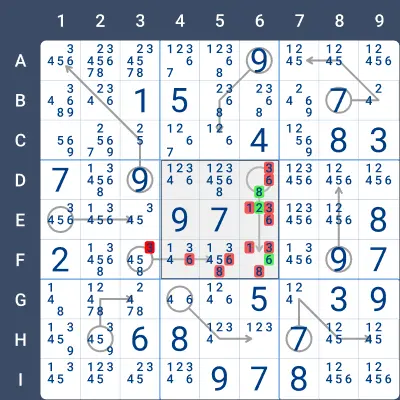
Examine the arrows in the shaded box 6 below. There are two arrows: one has its base at D7 (Arrow A) and the other at E9 (Arrow B). These arrows interact in several ways, resulting in eliminations.
Let’s analyze the decisions and eliminations:
-
D7 ≠ 3 & D7 ≠ 4: The digits on Arrow A must be either 1 & 2 or 1 & 3. However, Arrow B contains 3 digits in the same region, and two of these digits must be from 1, 2, and 3.
-
One of the digits on Arrow A must be 1 or 3: Any other pair of digits would result in a sum greater than 9.
-
E9 ≠ 6: If E9 were 6, the digits on Arrow B would need to be 1, 2, and 3. However, Arrow A must include either 1 or 3, creating a contradiction.
-
F7 = 2: Since Arrow A must contain 1 or 3, and Arrow B must contain two digits from 1, 2, and 3, Arrow B must include 2. The only cell that can hold 2 on Arrow B is F7.
-
F8 ≠ 3: If F8 were 3, then F9 would have to be either 1 (which is not possible because Arrow B cannot include 6) or the sum of Arrow B would exceed 9. Additionally, we cannot have two 3’s on the same arrow when the cells see each other
-
Possible digit combinations for Arrow B:
- 7 = 2, 4, 1
- 8 = 2, 5, 1
- 9 = 2, 1, 6 or 9 = 2, 4, 3
-
D7 ≠ 5: If D7 were 5, the digits along Arrow A would need to be 1 and 4. However, all possible combinations for Arrow B include either 1, 4, or both, which leads to a contradiction.
-
8 cannot be on Arrow A: If 8 were on Arrow A, the sum of Arrow A would have to be 9. But this would mean Arrow B wouldn’t include the digit 1, and its sum would also have to be 9 (using the combination 2, 3, 4). Since both arrows start in the same box, they cannot both sum to 9.
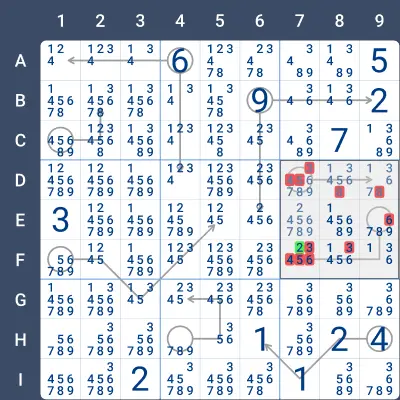
Practise this strategy with built-in step-by-step hints inside our apps.