Renban Lines
variantDigits on a Renban line must be distinct consecutive digits, arranged in any order. There are multiple Renban strategies with varying degrees of difficulty.
Digits on a Renban line must be distinct consecutive digits, arranged in any order. There are multiple Renban strategies with varying degrees of difficulty.
Renban Tips
- The digit 5 must appear on a Renban line of length 5 or longer.
- The digits 4 and 6 must appear on a Renban line of length 6 or longer.
Renban Strategies
1. HiddenSingle
Level: Simple
If only one digit is missing to complete the consecutive Renban sequence, the empty cell must contain that digit.
Example:
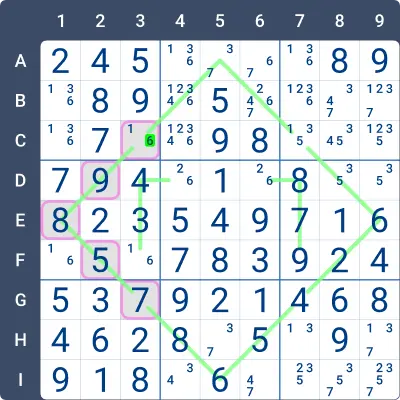
Look at the highlighted Renban line in the image below. The line is 5 cells long and already contains the digits 5, 7, 8, and 9. Only one cell (C3) is unsolved, and the digit 6 is missing to complete the consecutive sequence from 5 to 9. Therefore, C3 must be 6.
2. RequiredDigit
Level: Medium
This strategy identifies a digit that must be on a Renban line using two methods:
- By line length (e.g., the digit 5 must appear on a Renban line of five cells).
- A digit needed to fill the gaps and complete the consecutive sequence between the solved digits on the line.
Example:
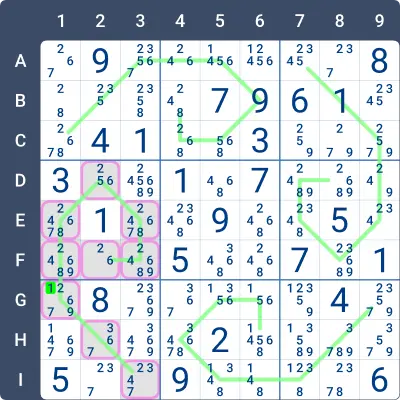
Look at the highlighted Renban line in the image below. It is 9 cells long, so all digits must be on the line, including 1.
- 1 cannot go in box 4 because there’s already a 1 in this box.
- 1 cannot go in H2 due to the 1 in column 2.
- 1 cannot go in G3 due to the 1 in column 3.
- The only remaining cell for 1 on the line is G1. Therefore, G1 = 1.
3. LockedSet - 1
Level: Advanced
This is an off-line elimination. If the line length or the digits already on the line indicate a specific digit must be on the line, eliminate that digit from any cell that can “see” all the cells where it could appear on the line.
Example:
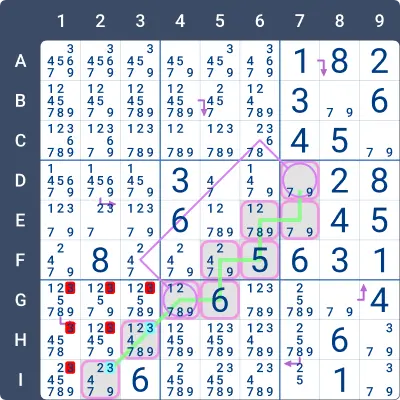
Look at the highlighted Renban line in the image below. It is 9 cells long, so all digits must be on the line.
- 3 cannot go in D7 and E7 because of the 3 in column 7.
- 3 cannot go in E6, F5, and G4 due to the 3 in D4.
- The only remaining cells for 3 on the line are in box 9: H3 and I2. H3 and I2 form a Locked Set of 3.
- Since both H3 and I2 are in box 9, 3 can be eliminated from other cells in box 9 that have 3 as a candidate.
4. LockedSet - 2
Level: Advanced
This is another off-line elimination strategy. By analyzing all possible combinations of consecutive digits for the line, you can identify a digit that must be on the line and is restricted to specific cells, then eliminate that digit from any cell that can “see” all the cells where it could appear on the line.
Example:
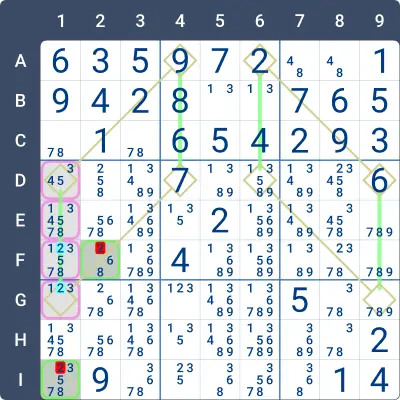
Look at the highlighted Renban line (D1, E1, F1, G1) in the image below. It is 4 cells long. 6 cannot be on this line. The only possible sequences are 1, 2, 3, 4 or 2, 3, 4, 5. Therefore, 2 must be on this line and can only be in F1 or G1.
- I1 sees both F1 and G1, so 2 can be eliminated from I1.
- The elimination of 2 from F2 is less obvious. If 2 is in F1, F2 cannot contain 2 due to lockout line rules. Similarly, if 2 is in G1, F2 still cannot contain 2. Therefore, 2 is eliminated from F2.
5. SmartEliminations
Level: Advanced
By analyzing all possible combinations of consecutive digits, you can make elimination decisions for several digits across multiple cells on the line.
Example 1:
Look at the shaded Renban line in cells F8 and G9. It is a two-cell-long Renban line.
- G9 doesn’t have 2 as a candidate, so 1 cannot be on this Renban line, and 1 can be eliminated from F8.
- Similarly, F8 doesn’t have 5 or 3 as candidates, so 4 can be eliminated from G9.
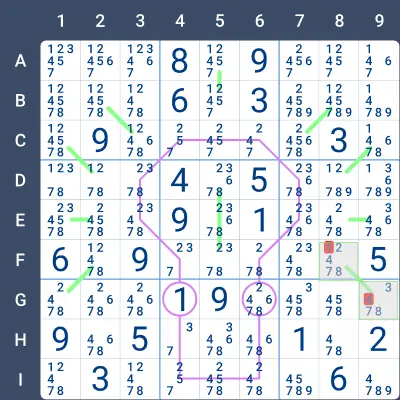
Example 2:
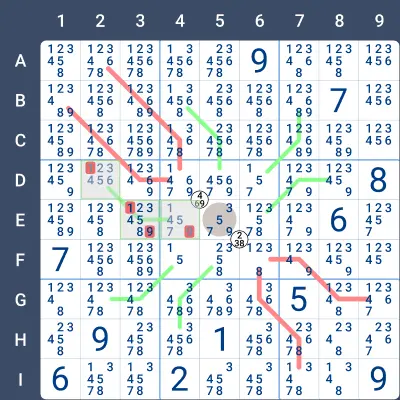
In this example, the eliminations are harder to see. Look at the Renban line in cells D2, E3, and E4. It is a 3-cell-long Renban line with a solution of 3 distinct consecutive digits in any order.
-
If 9 is on this Renban line, 7 and 8 must also be on the line, but D2 cannot have 7 or 8.
-
If 1 is in D2 or E3, 2 and 3 must also be on the line. However, E4 cannot have 2 or 3, so 1 cannot be in D2 or E3.
- Why can’t 3 be in E4? There’s a quadruple in box 5, meaning 3 must be in one of the surrounding cells, so it cannot be in E4.
Practise this strategy with built-in step-by-step hints inside our apps.