Ascending Sequences
variantIn Ascending Sequences, each row must contain as many ascending digit sequences as the number indicated to its left, while each column must contain as many ascending digit sequences as the number above it. An Ascending Sequence refers to a series of cells with digits that increase from left to right in a row, or from top to bottom in a column.
In Ascending Sequences, each row must contain as many ascending digit sequences as the number indicated to its left, while each column must contain as many ascending digit sequences as the number above it. An Ascending Sequence refers to a series of cells with digits that increase from left to right in a row, or from top to bottom in a column.
Ascending Sequences Guidelines:
- A sequence must always contain more than one digit.
- The numbers to the left of rows and above columns indicate the number of Sequences.
- An Ascending Sequence consists of digits arranged in increasing order. In a row, the smallest digit appears on the left, and the largest on the right. In a column, the smallest digit is at the top, and the largest is at the bottom.
- The digits in a sequence do not need to be consecutive, although they can be.
Ascending Sequences solving Tips:
- Apply the “What if” logic: Consider how many sequences a row or column might contain if a specific cell is assigned the digit ‘x’.
- A smaller digit following a larger digit always starts a new sequence, unless it appears in the last cell of the row or column.
- Focus on the digits 1, 2, 8, and 9:
- 1 always starts a sequence unless it’s the last digit in a row or column.
- 9 always ends a sequence unless it’s the first digit in a row or column.
- The same logic applies to 2 and 8, except when 2 follows 1 or 8 precedes 9.
SmartEliminations
Level: Advanced
By analyzing the digit permutations in the row/column, you can identify eliminations where placing a digit in a cell would disrupt the required number of ascending sequences. To approach this strategy effectively, consider testing ‘What If’ scenarios by placing specific digits in the cell.
Let’s look at a few examples and explain the logic.
Example 1
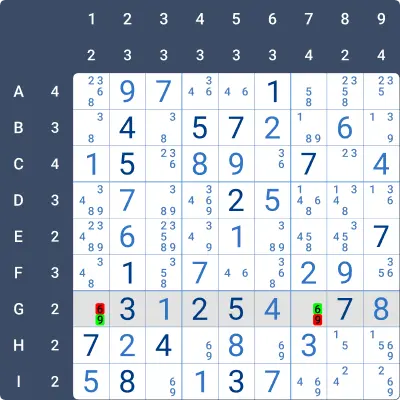
Examine the shaded row G. This row must contain exactly two sequences of ascending digits. Seven digits are already given, with only 6 and 9 remaining. In the current configuration, the row already has two ascending sequences: one of length 3 (1, 2, 5 in cells G3, G4, and G5), and another of length 2 (7, 8 in cells G8 and G9).
If G7 = 9, the board will have three ascending sequences: the two sequences mentioned above, plus a new one (4, 9 in G6 and G7). This creates an illegal situation, as the row would then contain more than two sequences. Therefore, G7 ≠ 9.
To complete the example, when G7 = 6, the row will contain exactly two ascending sequences: the first, 1, 2, 5 in cells G3, G4, and G5, and the second, 4, 6, 7, 8 in cells G6, G7, G8, and G9.
Example 2
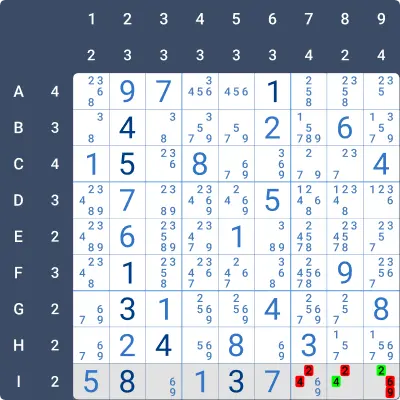
Examine the shaded Row I. This row must contain exactly two Ascending Sequences, which are already established: the first sequence is (5, 8), and the second is (1, 3, 7). The remaining digits for this row are 2, 4, 6, and 9, located in cells I3, I7, I8, and I9. These digits must be placed in such a way that no additional Ascending Sequences are created. Keep in mind that the digits can extend the existing sequences in the row.
-
If I7 = 2, an additional ascending sequence will be created, as any digit in I8 will form an ascending sequence between I7 and I8. Therefore, I7 ≠ 2.
-
If I8 = 2, applying the same logic as above, this will create an additional ascending sequence between I8 and I9. Therefore, I8 ≠ 2.
-
If I7 = 4, then I8 must be either 6 or 9, which would result in an additional ascending sequence between I7 and I8. Therefore, I7 ≠ 4.
-
The only remaining valid position for 4, according to classic Sudoku rules, is I8 = 4.
-
If I9 = 6 or I9 = 9, an additional ascending sequence will be formed between I8 and I9. Therefore, I9 ≠ 9, I9 ≠ 6, and I9 = 2.
Practise this strategy with built-in step-by-step hints inside our apps.