Killer
variantIn the Killer Variant, we examine which digits can fit in each cage and make decisions based on various board rules and restrictions. There are multiple Killer strategies with varying levels of difficulty.
In the Killer Variant, we examine which digits can fit in each cage and make decisions based on various board rules and restrictions. There are multiple Killer strategies with varying levels of difficulty.
All Killer strategies can be applied to both physical cages (shown on the puzzle) and Hidden Cages. Hidden cages are cages that can be deduced from the structure of the physical cages and the solved digits on the puzzle. In many cases, Hidden Cages are the only way to solve difficult puzzles. You can read more about hidden cages, how to create them, and manage them at the end of this document.
The app offers a Combination Panel that shows the possible digit combinations for every cage, both physical and hidden. When you select a cell or cells of a cage, the app’s combination panel displays all the digit combinations for that cage above the board. If you determine that a certain combination is not possible, you can press that combination on the panel, and it will become greyed out.
For an extra challenging experience, you can hide the combination panel in Game Settings.
Killer Tip:
It’s important to remember that the sum of each row, column, box, or region is always 45. 45 = 1 + 2 + 3 + 4 + 5 + 6 + 7 + 8 + 9
App Tip:
You can tap the View Hidden Cage link at the bottom of a hidden cage hint to see how the hidden cage was deduced.
Little Unique Killer
All the strategies described below, except for ‘Hidden Cages,’ can also be applied to the Little Unique Killer variant.
Killer Strategies
1. SingleCellCage
Level: Simple
If a cage contains only one cell, its value must equal the cage sum.
2. LastCageDigit
Level: Simple
If a cage is missing one digit, you can find it by subtracting the sum of the digits already in the cage from the total sum of the cage.
Example
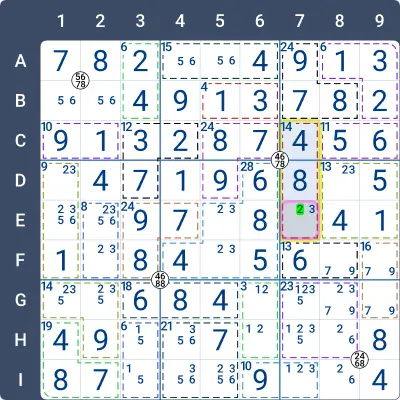
In the image below, the highlighted 14-sum cage in Column 7 is missing a single digit. The digits “4” and “8” are already solved.
The missing digit is calculated as: 14 - 4 - 8 = 2.
Therefore, E7 = 2.
3. LockedSet
Level: Medium
If a digit is confined to a specific set of cells in a cage, it can be removed from any cells that see all those specific cells.
Example
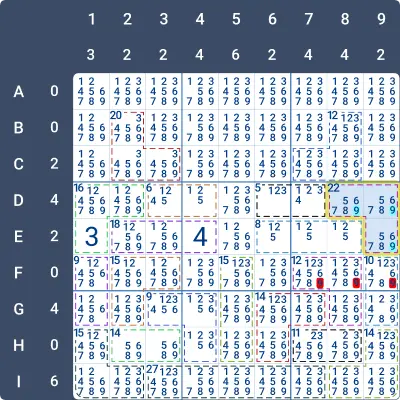
Look at the highlighted cage in the image below. The cage sum is 22. All the combinations for 22 must include the digit 9.
Combinations for 22: 9,8,5 , 9,7,6.
Since 9 must be one of the digits in this cage, we can eliminate 9 from all the cells that see all the cells of the cage.
4. BasedOnSumCombinations
Level: Advanced
By analyzing the possible combinations for a cage’s total sum and the rules of the board, you can identify digits that cannot fit in that cage.
Example 1
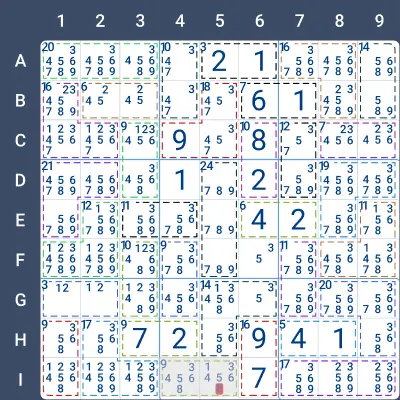
We are starting with a simple example. Look at the shaded cage of 9 in Row I.
The combinations for a cage of two cells with a sum of 9 are:
18, 27, 36, 45.
When looking at the combinations:
- The 18 combination: If I5 = 8, then I4 = 1. However, column 4 already contains a 1, so I5 ≠ 8.
- The 27 combination: There is already a 2 in both columns 4 and 5, so this combination is not possible in this cage.
- The remaining combinations: There is not enough data yet to make decisions or eliminations regarding the rest of the combinations for this cage.
Example 2
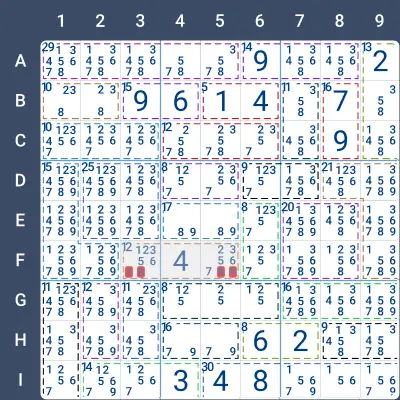
Look at the shaded cage in Row F; it is a three-cell cage with a sum of 12.
The combinations for “12” are:
129, 138, 147, 156, 237, 246, 345
The cage already has the digit 4, so all combinations that don’t include the digit 4 can be eliminated. After these eliminations, the following combinations remain:
147, 246, 345.
- None of the remaining combinations include the digits 8 or 9, so we can eliminate 8 and 9 from the cells in this cage.
- There is only one combination with the digit 7: 147. Since F5 cannot have the digit 1, we can eliminate 7 from F3.
Example 3
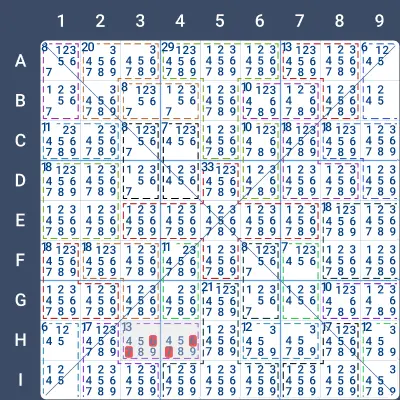
Here we are extending this strategy to the world of multiple variants. This board includes, in addition to classic Sudoku, the Non-consecutive and Diagonal variants.
Look at the shaded cage in Row H. It is a two-cell cage with a sum of 13.
Combinations for “13”:
49, 58, 67
Since the board has the Non-consecutive variant, the combination 67 can be eliminated because it would create adjacent consecutive digits, which are not allowed.
Hidden Cages
Hidden Cages are useful in boards that include the Killer variant, and sometimes Hidden Cages are the only way to solve the puzzle. After finding the Hidden Cage and its sum, killer strategies can be applied in the same way they are applied to physical cages.
What is a Hidden Cage?
A Hidden Cage is a cell or set of cells whose sum can be determined by the geometry of other cages and the digits already filled in.
In the Logic Wiz app, you can create a hidden cage and then use the app’s tools as if it were a physical cage on the board.
To create a Hidden Cage:
- Select multiple cells on the board.
- Press the calculator button above the board.
- Choose a sum for the hidden cage and press OK.
We created a YouTube video about hidden cages that you might find useful: Hidden Cages YouTube Video
Important: When you select the cells of multiple cages, the app shows their sum above the board on the right side.
The purpose of the examples below is both to teach what a hidden cage is and how to find it on your own.
Example 1
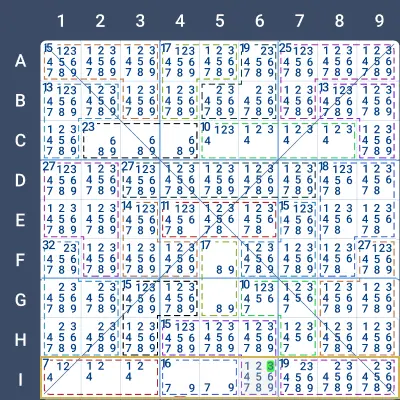
Starting with a simple Hidden Cage example. Look at the shaded cell I6 in the image below. I6 is a Hidden Cage with the sum of 3.
Why?
-
Look at Row I, the total sum of the row is 45, as explained above.
-
There are 3 cages in this row with sums of 7, 16, and 19.
-
From points 1 and 2:
I6 = 45 - 7 - 16 - 19 = 3
Example 2
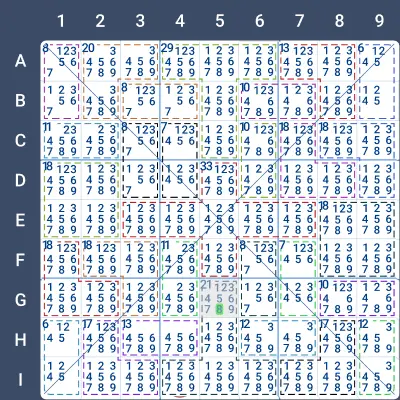
A bit harder example. Look at the shaded cell G5 in the image below. G5 is a Hidden Cage with the sum of 8.
Why?
-
Look at the bottom two rows. All the cells in these rows are part of cages, except for a single cage that includes cell G5.
-
The total sum of the bottom two rows is ( 2 times 45 = 90 ).
-
The sum of all the cages in the bottom two rows, including the cage of G5, is:
( 21 + 6 + 17 + 13 + 12 + 17 + 12 = 98 ).
-
From points 2 and 3 above:
G5 = ( 98 - 90 = 8 ).
Example 3
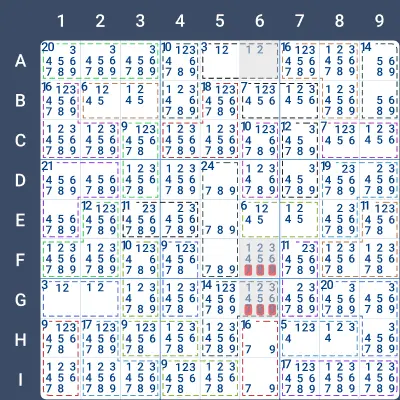
The cells A6, F6, G6 form a Hidden Cage with the sum of 9.
Why?
-
Look at the four right columns. All the cells in these columns are part of cages, except for A6, F6, G6. The sum of the cages is:
171 = 16 + 14 + 7 + 10 + 12 + 7 + 19 + 6 + 11 + 11 + 20 + 5 + 16 + 17.
-
The total sum of the four columns is ( 4 times 45 = 180 ).
-
From points 1 and 2 above:
A6, F6, G6 = ( 180 - 171 = 9 ).
Example 4
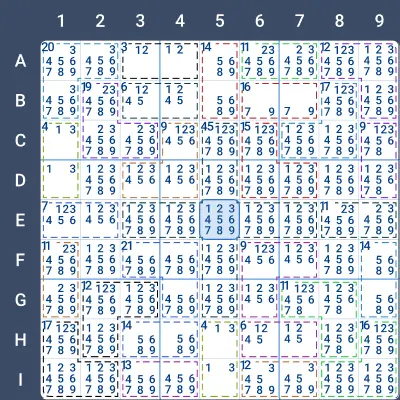
In this example, it gets more complicated and tricky. The highlighted cell E5 is a Hidden Cage with the sum of 9. Previously, we explored hidden cages that could be observed directly on the board. Here, it requires a few steps to deduce the hidden cage.
Steps:
- Look at column 5. The sum of all the cages in this column is: 63 = 14 + 45 + 4.
- The total sum of column 5 is 45.
- From points 1 and 2: E3 + E4 + E6 + E7 = 63 - 45 = 18.
- Now, look at row 5: E5 = 45 - 7 - 18 - 11 = 9.
Example 5
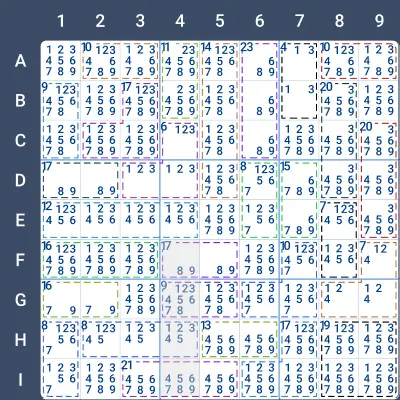
The highlighted cells F4, G4, H4, I4 are a Hidden Cage with the sum of 28.
This example combines a column and a box, making it harder to observe.
Steps:
- Look at Box 4 and Column 4. The total sum of these two is: 90 = 2 x 45.
- Sum the cages in Box 5 and the top 5 cells of Column 4: 62 = 17 + 12 + 16 + 11 + 6.
- From points 1 and 2: F4, G4, H4, I4 = 90 - 62 = 28.
Practise this strategy with built-in step-by-step hints inside our apps.