Lockout Lines
variantDigits along a Lockout line must be strictly outside the range of the digits in the squares at the ends of the line. The difference between the digits in the squares at the ends of the line must be at least 4.
Digits along a Lockout line must be strictly outside the range of the digits in the squares at the ends of the line. The difference between the digits in the squares at the ends of the line must be at least 4.
By examining the candidates at the ends of the line, the solved cells, the candidates along the line, and the puzzle rules, you can identify and eliminate candidates from various cells of the line.
Let’s see a few examples and explain the logic.
Example 1
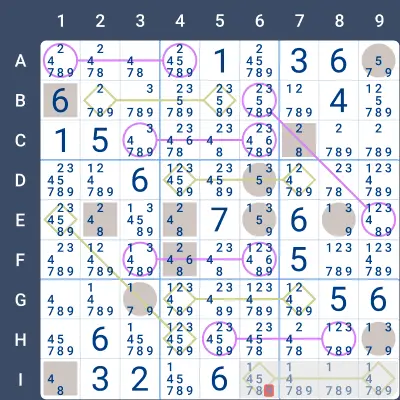
Look at the shaded Lockout line in Row I. If I6 = 9 → the digit in the other square will have to be either 1 or 4 to meet the rule that the digits in the squares must be 4 digits apart → no digit outside the range of the digits in the squares is left to fill the middle of the line → I6 ≠ 9.
Example 2
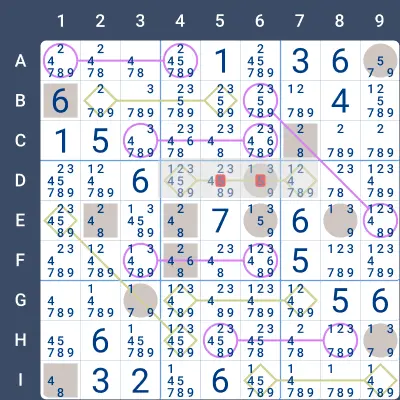
Look at the shaded Lockout line in Row D.
Can 5 be in the middle of this Lockout line?
When observing the candidates in the squares at the ends of the line and considering that the digits have to be at least 4 digits apart, it becomes clear that one digit at one of the ends has to be 5 or smaller, and the digit at the other end has to be 5 or greater, while maintaining the minimal distance of 4 between the digits at the ends of the line. Since the digits in the middle of the line have to be outside of the range of the digits at the edges, D5 and D6 cannot be 5.
Example 3
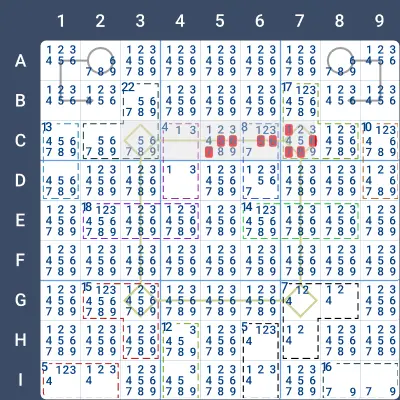
This is an interesting and relatively hard example, which requires extensive exploration of the different Lockout line combinations. Let’s examine the shaded Lockout line in Row C.
- At one end of the line (C3), the candidates are 5 or greater. The digit at the other end (C7) has to be smaller than 5 or 9. Therefore, we can eliminate 6, 7 & 8 from C7.
- The candidates in C4 are 1 & 3, meaning one of those digits has to be outside of the range of digits at the edges. If C7 = 1, C3 will have to be 5 or greater, and there will be no digit that can go in C4. Therefore, C7 ≠ 1.
- If C7 = 9 → C3 = 5 → 5, 6 & 7 cannot be in the middle of the line.
- If C7 = 2 → C3 = 6 or greater:
- If C3 = 6 → 5 & 6 cannot be in the middle of the line. In this case, the only digits outside the range are 1, 7, 8 & 9. C4 has to be 1, and if C5 = 7, there will be no digit that can go into C6. Therefore, C5 ≠ 7.
- If C3 > 6 → 5, 6 & 7 cannot be in the middle of the line.
- If 9 > C7 > 2 → C3 > 7 → 5, 6 & 7 cannot be in the middle of the line.
Practise this strategy with built-in step-by-step hints inside our apps.