Chain Violation Guard
expertChain Violation Guard is an advanced strategy where we eliminate candidates that, if chosen, would lead to a rule violation on the board. The key question to ask is, “What if?"—what would happen to the puzzle if a particular candidate were the solution for a given cell?
Chain Violation Guard is an advanced strategy where we eliminate candidates that, if chosen, would lead to a rule violation on the board. The key question to ask is, “What if?"—what would happen to the puzzle if a particular candidate were the solution for a given cell?
This strategy, my personal favorite among chaining techniques, has immense potential and can be applied far beyond the examples covered in this guide. Here, we will explore two specific cases of Chain Violation Prevention.
1 - NoDigitForRegion
Level: Advanced
This strategy focuses on identifying conflicts that arise when placing a specific digit in a cell would leave an entire region of the puzzle without one of the digits from 1-9. It requires thinking several steps ahead to anticipate and detect such conflicts.
Example
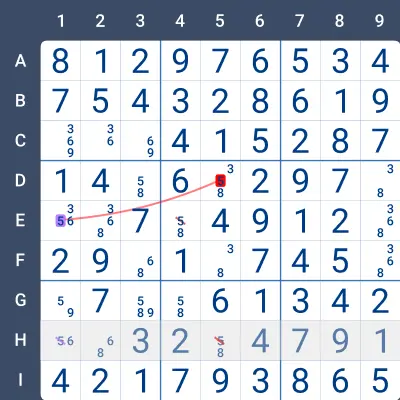
In the image below, if D5 = 5, there will be no valid placement for the digit 5 in Row H. The red links in the image represent the logical chain of decisions that follow if D5 = 5:
- If D5 = 5, then D3 ≠ 5 and H5 ≠ 5.
- This forces E1 = 5, which in turn eliminates H1 ≠ 5.
As a result, placing 5 in D5 removes all possible locations for 5 in Row H, creating a rule violation. Therefore, D5 cannot be 5.
2 - CellEmptied
Level: Advanced
This strategy focuses on identifying conflicts that arise when placing a specific digit in a cell would leave another cell of the puzzle with no candidates. It requires thinking several steps ahead to anticipate and detect such conflicts.
Example:
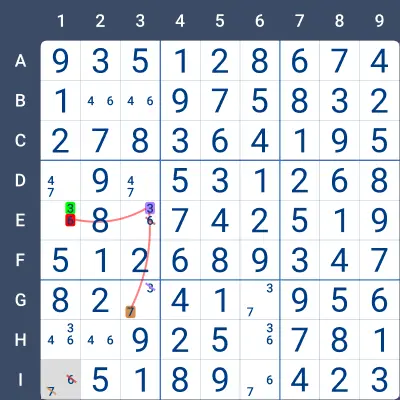
The image below illustrates a short chain showing that placing 6 in E1 would leave I1 with no valid candidates, resulting in a violation. Let’s break it down:
- If E1 = 6, then I1 ≠ 6.
- This leads to E3 = 3, which forces G3 = 7.
- Consequently, I1 ≠ 7 as well.
Thus, placing 6 in E1 eliminates both 6 and 7 as candidates for I1, causing a violation. Therefore, E1 ≠ 6.
3 - ViolateRules
Level: Advanced
This strategy focuses on identifying rule violations that occur when placing a specific digit in a cell. It requires thinking several steps ahead to anticipate and detect potential conflicts.
Example
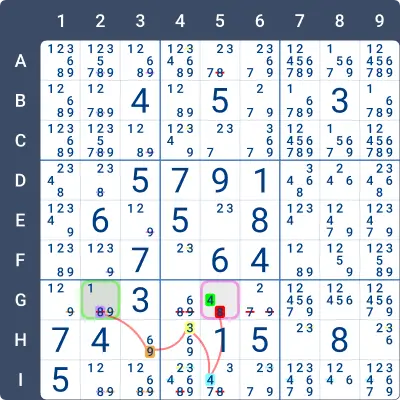
This example highlights multiple violations, but we’ll focus on rule violations. The puzzle in the image below includes the Non-consecutive variant.
The image illustrates a short chain starting at G5:
- Placing 8 in G5 forces I5 = 4, eliminating all other 8’s in Row G and Box 8.
- This, in turn, eliminates the 3’s in I4 and I6, forcing H4 = 3.
- As a result, H3 = 9 (since it’s the only remaining 9 in Row H), eliminating all other 9’s from Box 7.
- Now, G2 is left with 1 as its only candidate, which eliminates 1 from G1. G1 is then left with 2 as its sole candidate. However, due to the Non-consecutive rule, 2 cannot be placed adjacent to 1.
Therefore, G5 cannot be 8 and must be 4.
Practise this strategy with built-in step-by-step hints inside our apps.