3D Medusa
expert3D Medusa is an extension of Simple Coloring, expanding it into a multi-digit chain of Strong Links. Simple Coloring involves creating a chain of Strong Links for a single digit, enabling the elimination of candidates either within or outside the chain. In 3D Medusa, we extend this concept by chaining Strong Links across multiple digits. Bi-value cells, which contain only two candidates, facilitate this chaining. Since these two candidates form a Strong Link (if one is false, the other must be true), they allow us to extend Simple Coloring into a multi-digit chain, enabling more advanced eliminations both on and off the chain.
3D Medusa is an extension of Simple Coloring, expanding it into a multi-digit chain of Strong Links. Simple Coloring involves creating a chain of Strong Links for a single digit, enabling the elimination of candidates either within or outside the chain. In 3D Medusa, we extend this concept by chaining Strong Links across multiple digits. Bi-value cells, which contain only two candidates, facilitate this chaining. Since these two candidates form a Strong Link (if one is false, the other must be true), they allow us to extend Simple Coloring into a multi-digit chain, enabling more advanced eliminations both on and off the chain.
The Core Idea:
In 3D Medusa, one of the alternating colors must represent the true solution. This principle helps us identify contradictions and make eliminations both on and off the chain. 3D Medusa encompasses six elimination rules, which we’ll explain and demonstrate below.
How to Construct a 3D Medusa?
- Start with Simple Coloring: Create a Simple Coloring chain for a single digit (a) with alternating colors.
- Extend with Bi-value Cells: Identify bi-value cells on the chain and initiate Simple Coloring for a second digit (b). The color of b in the bi-value cell should alternate with the color of a.
- Continue Chaining: Repeat step 2 for additional bi-value cells on the chain, linking more digits as needed.
Example
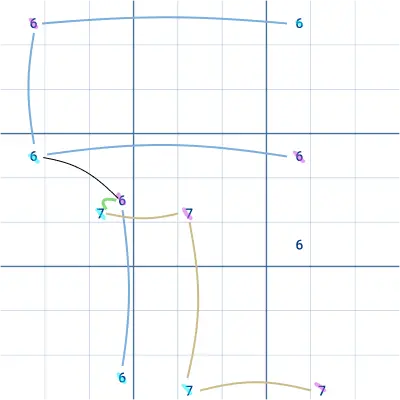
The image below illustrates a 3D Medusa chain. Observe the Simple Coloring chain for the digit 6 (blue Strong Links). Cell E3 is part of this chain and is a bi-value cell containing 6 and 7. The relationship between 6 and 7 in E3 forms a Strong Link. From E3, a new Simple Coloring chain for 7 begins (shown in a brownish color for Strong Links), starting with the alternating color of 6 in E3. If there were more bi-value cells along the chain, they could extend further.
It’s evident from the chain’s structure that either the 6 and 7 with the purple color are the correct solutions for the board, or the 6 and 7 with the turquoise color are correct. This understanding allows for multiple types of eliminations and decisions, both on and off the chain. Below, we provide examples and explanations for each of the six types of eliminations possible with 3D Medusa.
3D- Medusa Strategies
1. TwiceInCell
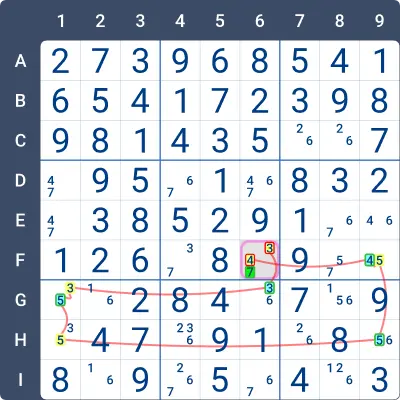
TwiceInCell is an on-chain elimination technique. This occurs when a cell in the chain contains two different candidates with the same color. Since one of the colors must be correct, having two candidates of the same color in a single cell would violate the Sudoku rules. Therefore, all candidates of this color can be eliminated, and the candidates of the opposite color must be the correct solution.
Example:
Refer to the image below. The chain is constructed with Strong Links connecting multiple candidates. The highlighted cell F6 contains both 3 and 4 colored in yellow. Since one of these colors must be correct, and a cell can only have a single correct digit, the yellow color can be eliminated. Consequently, the light blue color (outlined in dark green) must represent the correct solution.
2. TwiceInRegion
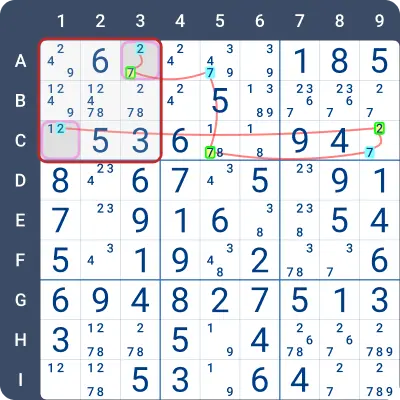
TwiceInRegion is an on-chain elimination technique. Since the chain is constructed such that one color must represent the correct solution, if two instances of the same digit in the same color can see each other (i.e., are in the same row, column, or box), it creates a contradiction. This implies that the other color must be correct.
Example:
Refer to the image below. The chain is constructed with Strong Links connecting multiple candidates. The highlighted cells A3 and C1 within the highlighted Box 1 both have the digit 2 colored in light blue. If light blue were the correct color in this 3D-Medusa chain, Box 1 would contain the digit 2 twice, which is a contradiction. Since one of the colors must be correct, light blue cannot be the correct solution. Therefore, the yellow color marks the correct placement of the digits.
3. TwoColorsInCell
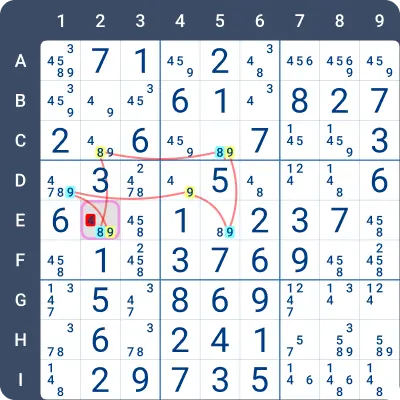
TwoColorsInCell is an on-chain elimination technique. Since the chain is constructed such that one color must represent the correct solution, if both colors appear in the same cell, one of them must be the correct answer. This allows you to eliminate any other candidates in that cell.
Example:
Refer to the 3D-Medusa in the image below. Cell E2 contains both the yellow and light blue colors. Since one of these colors must represent the correct placement for the digits on the chain, other candidates in this cell can be eliminated. Therefore, the digit 4 can be removed from E2.
4. TwoColorsElsewhere
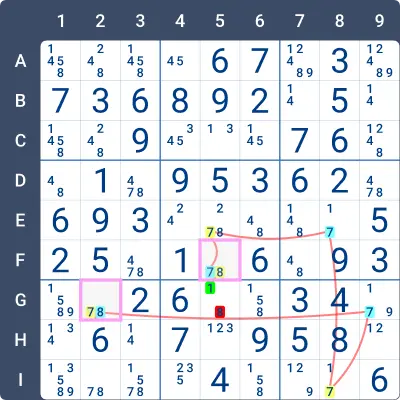
TwoColorsElsewhere is an off-chain elimination technique. Since one color must be correct, if a digit “sees” two identical digits with different colors, it can be eliminated from the cell.
Example:
Refer to the image below. The digit 8 in G5 sees a yellow 8 in F5 and a light blue 8 in G2. Since one of these colors must be the correct solution, 8 can be eliminated from G5, leaving G5 = 1.
5. TwoColorsRegionPlusCell
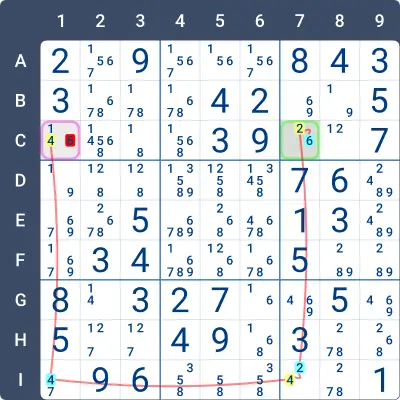
TwoColorsRegionPlusCell is an on-chain elimination technique. It occurs when a digit (A) in cell X, part of the chain, sees the same digit (A) with one color elsewhere on the chain and also contains another candidate (B) with the alternate color in the same cell (X). In this scenario, digit A in cell X can be eliminated.
Example:
Refer to the image below, which illustrates a 3D-Medusa chain. The 6 in C1 sees a 6 in light blue in C7 and has the digit 4 in yellow within its cell. Since one of the colors must be correct, 4 can be eliminated from C1.
Why?
- If the light blue color is correct, C7 must be 6, and C1 cannot be 6.
- If the yellow color is correct, C1 must be 4.
- The conclusion is that regardless of which color is correct, C1 cannot be 6.
6. CellEmptiedByColor
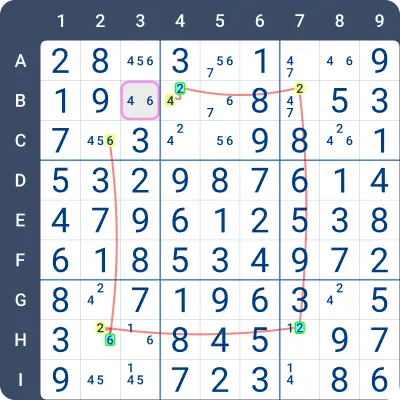
Cell Emptied by Color is an on-chain elimination technique. Since one color must be correct, if a particular color leaves a cell with no candidates, the other color must be the correct solution.
Example:
The image below illustrates a 3D-Medusa chain, where one of the colors represents the correct placement of digits on the chain. Consider cell B6, which has two candidates: 4 and 6. If yellow is the correct solution for the chain:
- B6 will see a yellow 4 in B4 and a yellow 6 in C2.
- As a result, B6 will be left with no candidates, creating a contradiction.
Therefore, yellow cannot be the correct color, and light blue must represent the correct placement of digits.
Practise this strategy with built-in step-by-step hints inside our apps.