Swordfish
expertA Swordfish pattern occurs when a digit X is a candidate in exactly three rows, and in each row, X appears only in the same three columns. This means X must be placed in those cells, and it can be eliminated from other rows within those columns. Similarly, the strategy also works if rows and columns are swapped in this description. Swordfish doesn’t have to include the digit in all the 9 cells of the pattern.
Swordfish is an advanced Sudoku solving strategy, similar to X-Wing. While X-Wing involves a 2x2 cell pattern, Swordfish uses a 3x3 cell pattern with similar logic to eliminate candidates. Swordfish occurs when 3 rows (or columns) each have exactly 3 candidates of the digit ‘A’ in the same columns (or rows). This is a single-digit strategy, focusing on the candidates of one digit only.
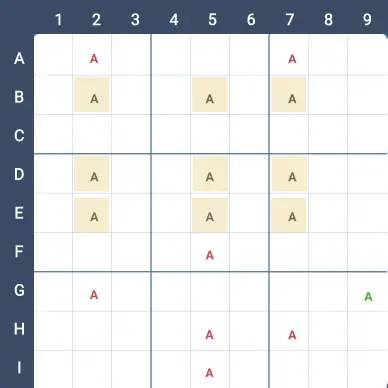
In the image below, in rows B, D, and E, the digit A resides in columns 2, 5, and 7. This is a Swordfish pattern. It means that in rows B, D, and E, the digit A must be in columns 2, 5, and 7. Consequently, every candidate of A in these three columns, which is not part of the pattern, can be eliminated. The red A’s in the image can be eliminated, while the green A remains unaffected by the Swordfish pattern.
Why is it true?
In rows B, D, and E, the digit A must be in columns 2, 5, and 7. Since no column can contain two A’s, one A must occupy each of these columns in these rows. Therefore, the digit A in columns 2, 5, and 7 must be within the pattern’s cells, allowing us to eliminate all other candidates of A from cells not part of the pattern in these columns.
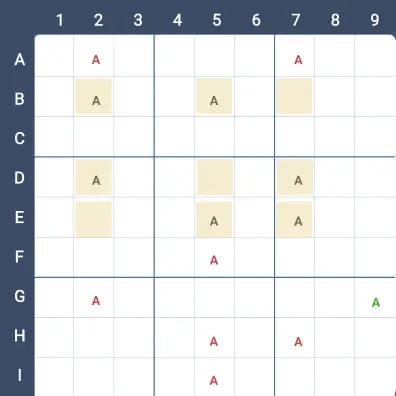
Swordfish doesn’t require all 9 cells of the pattern to contain the digit. It is sufficient if, in three rows (or columns), all candidates of a digit are located in the same three columns (or rows). In the image below, some A’s from the previous example have been removed. This doesn’t change the fact that in rows B, D, and E, the digit A must still be in columns 2, 5, and 7. The eliminations remain the same; we can eliminate all candidates of A from cells not part of the pattern in these columns (or rows).
Example 1
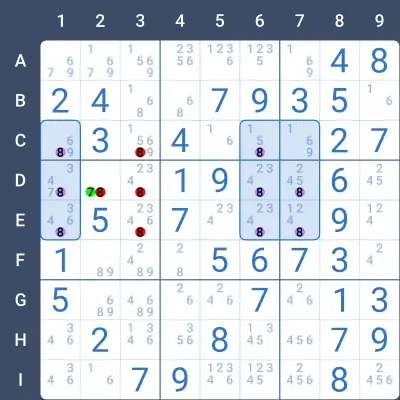
In the image below, the highlighted cells form a Swordfish for the digit 8. In columns 1, 6, and 7, 8 can only be in rows C, D, and E. Since cell C7 doesn’t have 8 as a candidate, in columns 1, 6, and 7, 8 must be in rows C, D, and E. We can eliminate all candidates of 8 in rows C, D, and E from cells not part of the Swordfish pattern, marked in red.
Example 2
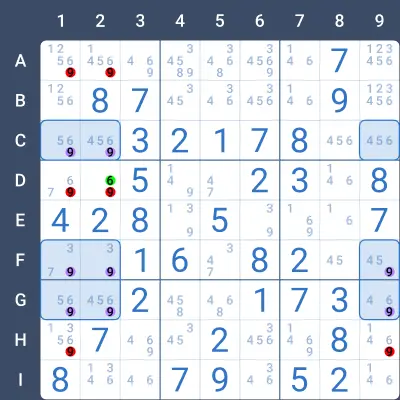
In the image below, the nine highlighted cells form a Swordfish for the digit 9. In rows C, F, and G, 9 can only be in columns 1, 2, and 9. Although cell C9 doesn’t contain the digit 9 because there’s already a 9 in Box 3, it remains a Swordfish. The 9’s in columns 1, 2, and 9 must be in one of the cells of the pattern. All other candidates of 9 in these columns can be eliminated from cells not part of the Swordfish, marked in red.
Example 3
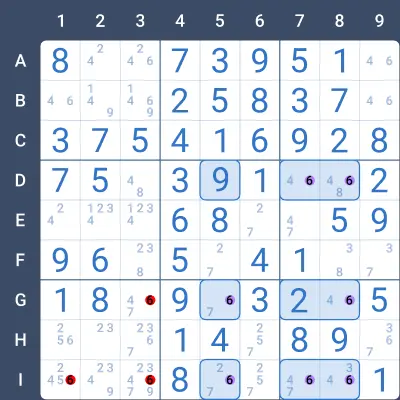
In the image below, observe why the highlighted cells form a Swordfish for the digit 6.
Practise this strategy with built-in step-by-step hints inside our apps.