Simple Coloring
expertSimple Coloring, also known as Simple Chain, is a chaining strategy used on a single digit for eliminations. It’s an advanced technique involving a series of Strong Links connected to form a chain. The minimum requirement to create a chain is two Strong Links that can be connected.
Simple Coloring, also known as Simple Chain, is a chaining strategy used on a single digit for eliminations. It’s an advanced technique involving a series of Strong Links connected to form a chain. The minimum requirement to create a chain is two Strong Links that can be connected.
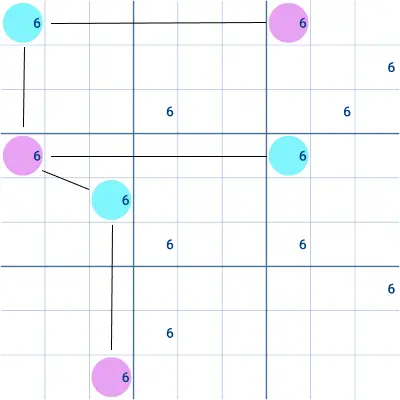
In Simple Coloring, we use two different colors (hence, the ‘Coloring’ in the strategy’s name), one for each end of the Strong Link. See the image below. All Strong Links that can form a chain are connected, ensuring each side of a Strong Link has a different color. Additional Strong Links (like in row 3, row 5, and column 9) may exist but cannot connect to another Strong Link. Since a Strong Link guarantees that if one cell is not the solution, the other must be, it follows that one color in the chain represents the solution, while the other does not.
Types of Eliminations in Simple Coloring:
-
Rule 1 - On-chain elimination: If more than one cell in a region has the same color, that color cannot represent the solution for the digit. This is because having multiple identical digits in a region would violate Sudoku rules.
-
Rule 2 - Off-chain elimination: If a cell outside the chain OFF the chain ( not part of the chain ) can sees both colors, the digit in that cell can be eliminated. This is because one of the alternating colors must be the solution, making any digit that sees both colors redundant.
Below are examples to clarify these concepts.
Example 1: On-chain Elimination
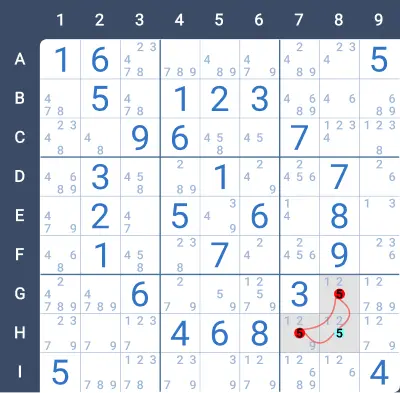
In the example below, two Strong Links for the digit 5 form a Simple Coloring chain on 5. The first Strong Link is in Column 8, where 5 must be in either G8 or H8. The second Strong Link is in Row H, where 5 must be in either H7 or H8. These Strong Links connect at H8. Although it’s a short chain, the red-colored 5 appears twice in Box 9. According to Rule 1, if a color appears multiple times in a region, those cells cannot contain the digit. Thus, the blue color represents the solution for 5.
Example 2: Off-chain Elimination
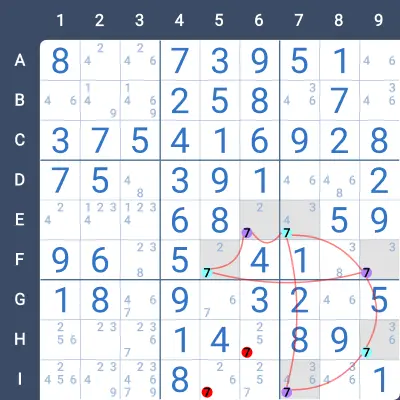
In this example, a Strong Links chain is formed on the digit 7. Each red arc connects two digits, representing the only options for 7 in their respective Regions. Since one of the alternating colors (purple or blue) must be the solution for 7, any 7 outside the chain that can “see” both colors can be eliminated. The highlighted 7s in red are eliminated for this reason.
Example 3: Off-chain Elimination with a Longer Chain
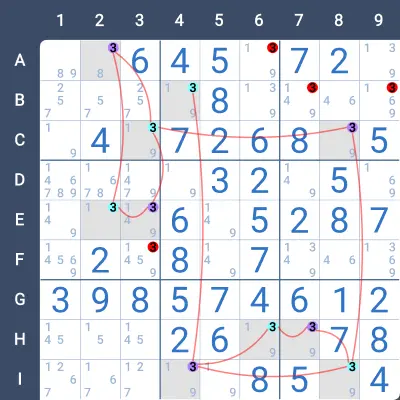
This example uses a longer chain on the digit 3. Each red arc connects two digits, the only options for 3 in their respective Regions. Examine the eliminations highlighted in red and understand how the chain was constructed.
Example 4: Complex Board with Variants
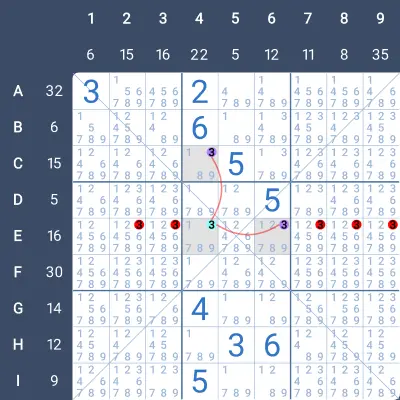
The board below includes Classic Sudoku and three variants: Sandwich, Non-Consecutive, and Diagonal. In Column 3, there are only two possible placements for 3: C4 and E4, forming a Strong Link. Similarly, in Box 5, the only two placements for 3 are E4 and E6, also forming a Strong Link. Using Rule 2, we can eliminate the highlighted 3s in Row E that are not part of the chain but can “see” both colors.
Example 5: Advanced Board with Chess King and Thermo Variants
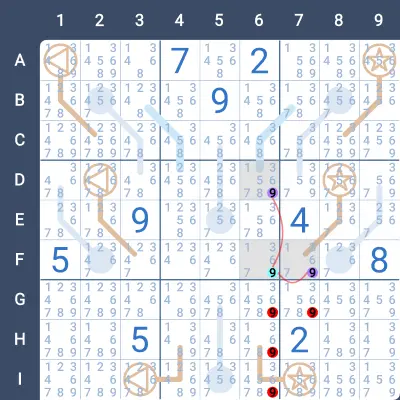
In this example, the board includes Classic Sudoku and two additional variants: Chess King and Thermo. In Box 5, D6 and F6 form a Strong Link for the digit 9. Similarly, F6 and F7 form a Strong Link on 9 in Row F. Using off-chain elimination, we can remove the highlighted 9s from G6, H6, I6, and G7 based on the rules of both Classic Sudoku and Chess King.
Practise this strategy with built-in step-by-step hints inside our apps.