Jellyfish
expertA Jellyfish pattern occurs when a digit X is a candidate in exactly four rows, and in each row, X appears only in the same four columns. This means X must be placed in those cells, and it can be eliminated from other rows within those columns. Similarly, the strategy also works if rows and columns are swapped in this description. Jellyfish doesn’t have to include the digit in all the 16 cells of the pattern.
Jellyfish is an advanced Sudoku strategy that is very robust. It takes Swordfish one step further and uses similar logic to make smart decisions.
In Jellyfish, we look at a 4x4 cell pattern, while Swordfish involves a 3x3 cell pattern. While it is not easy to spot a Jellyfish pattern, with practice, it becomes easier to identify.
What is Jellyfish?
Jellyfish occurs when 4 Rows (or Columns) each have only 4 candidates of the digit ‘A’ in exactly the same Columns (or Rows). This is a single-digit strategy, meaning it focuses on the candidates for just one digit.
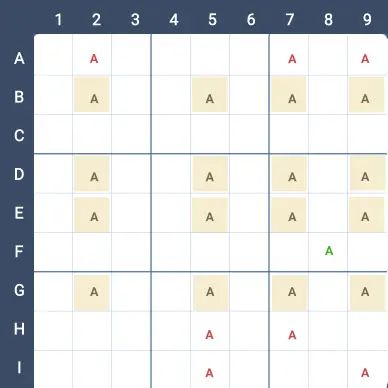
Look at the image below. In Rows B, D, E, and G, the digit A appears in Columns 2, 5, 7, and 9. This is a Jellyfish pattern.
It means that in Rows B, D, E, and G, the digit A must appear in Columns 2, 5, 7, or 9. As a result, we can eliminate every candidate of A in these four columns in cells that are not part of the pattern. The red A’s in the image can be eliminated. The green A is not affected by the Jellyfish pattern and cannot be eliminated.
Why is it True?
In Rows B, D, E, and G, the digit A must appear in Columns 2, 5, 7, and 9. Since no Column can contain two A’s, it must be that in these rows, A will appear once in each of these columns. This means that the digit A in Columns 2, 5, 7, and 9 must be placed in cells that are part of the pattern, allowing us to eliminate all the candidates of A from cells that are not part of the pattern in these columns.
Jellyfish doesn’t require the digit to appear in all 16 cells of the pattern. It is enough that in four Rows (or Columns), all the candidates for a digit are located in the same four Columns (or Rows, respectively).
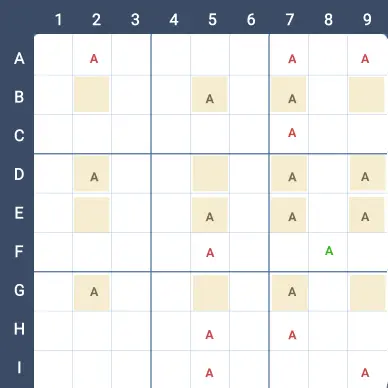
Look at the image below. We have removed some of the A’s from the previous example. Removing these A’s does not change the fact that in Rows B, D, E, and G, the digit A must appear in Columns 2, 5, 7, and 9.
The elimination process remains the same. We can still eliminate all the candidates for A from cells that are not part of the pattern in these Columns (or Rows).
Example 1
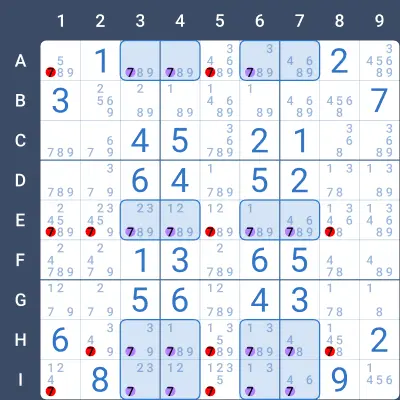
The image below shows a Jellyfish pattern for the digit 7. In Columns 3, 4, 6, and 7, the digit 7 is a candidate only in Rows A, E, H, and I. This means that the 7 in these rows must be placed in the cells of the Jellyfish pattern.
As a result, in these rows, we can eliminate the candidates for 7 from cells that are not part of the Jellyfish.
Important Note:
Notice that cell A7 does not have 7 as a candidate. However, this does not affect or change the elimination process.
Example 2
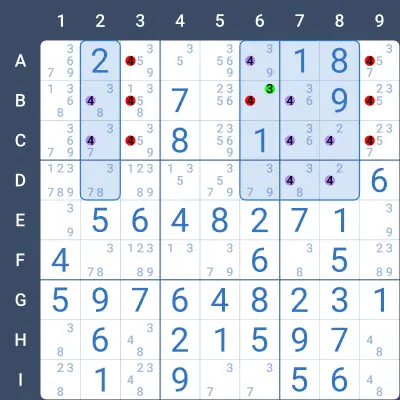
The image below shows a Jellyfish pattern for the digit 4. At first glance, it may seem like an unusual Jellyfish, as multiple cells in the pattern do not have 4 as a candidate. However, upon closer examination, we can see that in Columns 2, 6, 7, and 8, the digit 4 is optional only in four rows: A, B, C, and D. Moreover, in each of these rows, the 4 must be placed in the cells of the Jellyfish.
Key Observations:
The eliminations and decisions that follow once we identify the pattern are very robust. All the 4’s highlighted in Red can be eliminated, and as a result:
- A6 must be 4.
- B6 must be 3.
Example 3
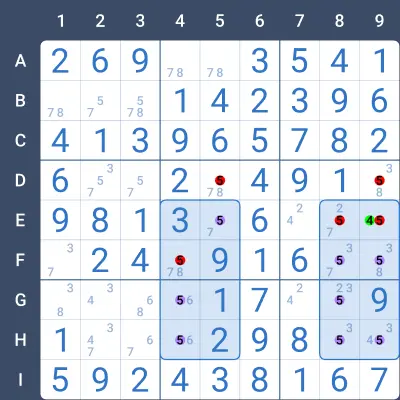
In the image below, we have a Jellyfish pattern for the digit 5. In Rows E, F, G, and H, the digit 5 is a candidate in exactly four Columns: 4, 5, 8, and 9.
Additional Observation:
Notice that you could also identify a Swordfish pattern for 5 in Rows F, G, H and Columns 4, 8, and 9.
Please examine the image carefully and verify that you understand the eliminations and decisions that result from the Jellyfish pattern.
Practise this strategy with built-in step-by-step hints inside our apps.