Skyscraper
variantSkyscraper involves examining a column or row from the perspective of the skyscraper clue outside the grid and making eliminations and decisions based on several parameters: the clue outside the grid, digits in the row or column, candidates in cells, digit placement to achieve the Skyscraper, and the board variants.
Skyscraper involves examining a column or row from the perspective of the skyscraper clue outside the grid and making eliminations and decisions based on several parameters: the clue outside the grid, digits in the row or column, candidates in cells, digit placement to achieve the Skyscraper, and the board variants.
Few Tips:
- The number 1 outside the grid suggests that the digit next to the 1 must be 9, effectively concealing the rest of the skyscrapers.
- The number 9 outside the grid implies that all the digits must be in order, from 1 to 9.
- A large digit conceals all the lower skyscrapers after it from the viewpoint of the skyscraper number.
- Unless the number outside the grid is 1, 9 cannot be in the first cell of the row or column.
- When approaching the puzzle, start by focusing on tall skyscrapers, as they indicate that the higher numbers are likely close to the end of the row or column.
- Consider using highlight markers to mark cells where 7, 8, and 9 cannot go, providing additional clarity in the solving process.
- Using the drawing tool to depict ‘<’ and ‘>’ between cells can be beneficial, indicating the relationship and order between them.
Smart Eliminations
Level: Advanced
By analyzing all possible digit combinations in a row or column, you can eliminate digits that would violate the Skyscraper count if placed in that cell.
This strategy is best explained through examples.
Example 1:
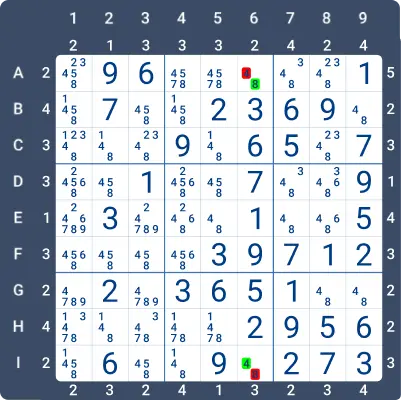
We are examining the skyscraper number at the top of Column 6. The count of skyscrapers is 2, and the candidates for cell A6 are 4 and 8.
- If A6 = 4, the visible skyscrapers in Column 6 from the top would be: 4, 6, 7, & 9, totaling 4 skyscrapers. Therefore, A6 ≠ 4.
- If A6 = 8, the visible skyscrapers from the top are 8 and 9, which matches the clue.
Example 2:
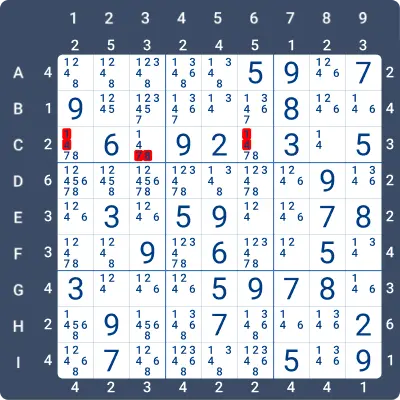
In Row C, there must be only 2 skyscrapers visible from the left and 3 skyscrapers visible from the right.
- If C1 = 1, the skyscrapers in Row C from the left are: 1, 6, 9 (and if C3 is 7 or 8, an additional skyscraper appears).
- If C1 = 4, the skyscrapers from the left are: 4, 6, 9 (and if C3 is 7 or 8, an additional skyscraper appears).
Thus, C1 ≠ 1 and C1 ≠ 4, leaving 7 and 8 as the remaining candidates for C1.
Now, from the right side:
- If C6 = 1 or 4, only 2 skyscrapers (5 and 9) would be visible, but we need 3. Therefore, C6 ≠ 1 and C6 ≠ 4.
From this point, classic Sudoku logic dictates that both C1 and C6 have only 7 and 8 as candidates, meaning C3 and C8 must be 1 and 4.
Example 3:
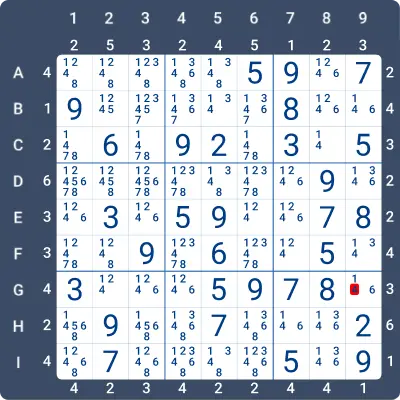
Row G must have 4 skyscrapers from the left and 3 skyscrapers from the right.
Each candidate in G9 will result in 3 skyscrapers from the right. On the left side, if the candidates in G2, G3, & G4 are 1, 2, & 6, only 3 skyscrapers (3, 6, & 9) would be visible, but we need 4. Therefore, 4 must be a candidate in these cells, implying G9 ≠ 4.
Practise this strategy with built-in step-by-step hints inside our apps.