Slingshot
variantIn Slingshot, arrows on the board point from a cell with digit X (Origin Cell) towards the same digit X (Target Cell), where the digit in the arrow cell (Y) (Distance Cell) indicates how many cells the digit X is away from the arrow, excluding the cell with the arrow itself.
In Slingshot, arrows on the board point from a cell with digit X (Origin Cell) towards the same digit X (Target Cell), where the digit in the arrow cell (Y) (Distance Cell) indicates how many cells the digit X is away from the arrow, excluding the cell with the arrow itself.
Slingshot has multiple strategies with varying degrees of difficulty that can be applied in different scenarios.
Slingshot Tips
- The Origin and Distance cells can never be in the same box.
- The maximum value for the Distance cell is 8.
- Focus on Slingshots pointing from a ‘close’ distance to the edges of the puzzle. The Distance cell of such a Slingshot has a relatively short list of candidates.
Slingshot Strategies
1. LastCell
Level: Medium
If the digits in two of the three Slingshot cells are known, you can calculate the digit for the third cell.
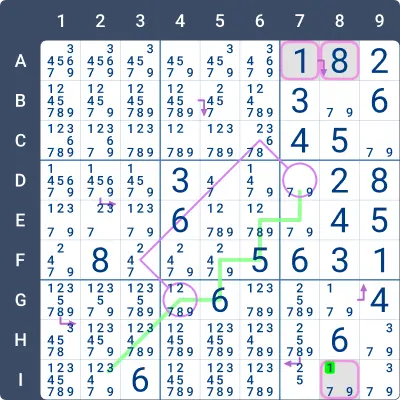
Look at the highlighted Slingshot in the image below. The Origin (A7) and Distance (A8) cells are already solved, with 1 and 8, respectively. The Target cell must also be 1, which should be 8 cells away from A8, not counting A8 itself. Therefore, 1 goes in I9.
2. TargetToOrigin
Level: Medium
If a solved digit in the row or column of the Target cell is outside the range of possible values for the Target, that digit cannot be the solution for the Target cell and can also be eliminated from the Origin cell.
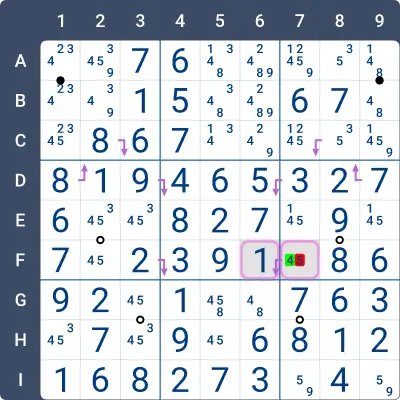
Look at the highlighted Slingshot in the image below. The Origin cell (F7) has 4 and 5 as candidates. In Column 6, where the Target cell should be, 5 is already solved and appears in D6, which is in the opposite direction of the Slingshot. Therefore, 5 can be eliminated from the Origin cell, and 4 goes in F7.
3. Unshared
Level: Medium
When the Slingshot Distance cell is solved, eliminate any candidates that are not shared between the Origin and Target cells.
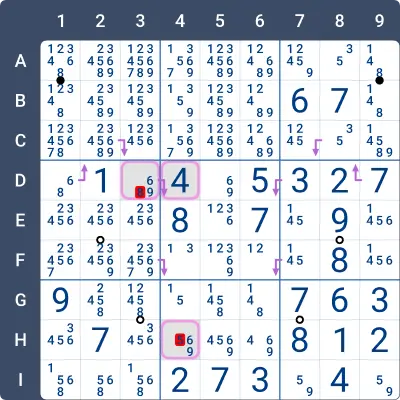
Look at the highlighted Slingshot in the image below. The Distance cell D4 is solved, so the Target cell is known and should be H4. Since the Origin and Target cells must have the same digit, only candidates shared between them are valid solutions.
Eliminations:
- 8 in D3 is not a candidate in H4, so it can be eliminated.
- 5 in H4 is not a candidate in D3, so it can be eliminated.
4. OriginAndDistance
Level: Medium
Eliminate candidates from both the Origin and Distance cells based on the following rules:
- Origin Eliminations: Remove candidates from the Origin cell if they don’t appear as candidates in any of the possible Target cells.
- Distance Eliminations: Remove a candidate from the Distance cell if the corresponding Target cell does not share any candidates with the Origin cell.
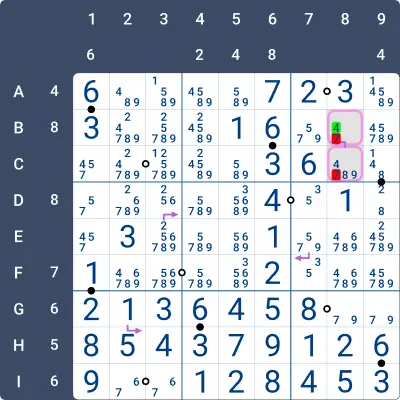
Look at the highlighted Slingshot in the image below.
- An Origin candidate is valid only if the potential Distance cells have this candidate. B1 and B4 are the possible Distance cells for this Slingshot. Neither has 7 as a candidate, so 7 can be eliminated from C8.
- A Distance candidate is valid only if the Origin and Distance cells share the same candidate for that Distance. The Distance cell B1 is already solved with the digit 3. The Origin cell does not have 3 as a candidate. Therefore, 7 in B8 can be ruled out, and B8 must be 4.
Practise this strategy with built-in step-by-step hints inside our apps.