Unique Rectangle
expertThe Unique Rectangle strategy ensures the puzzle has only one solution by eliminating candidates that would create a Deadly Rectangle, which could result in multiple solutions. When four cells in two boxes, two rows, and two columns share the same two candidates, it creates the risk of a Deadly Rectangle. To avoid this, one of these cells must have a different digit as its solution.
Unique Rectangle is a powerful strategy that relies on the fact that a Sudoku board must have only one solution. All puzzles in the Logic Wiz app have a single unique solution.
This strategy cannot be applied to boards without a single unique solution.
The strategy applies to multiple situations, and we’ll explain the majority. Before exploring the strategy, we will define the term Deadly Pattern (or Deadly Rectangle). When a deadly pattern is encountered, the board doesn’t have a unique solution.
What is a Deadly Pattern?
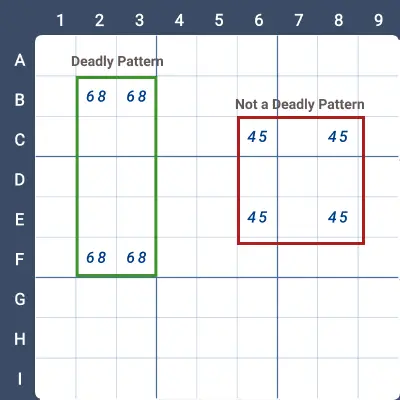
A Deadly Pattern occurs when 2 rows and 2 columns in 2 boxes have only 2 possible digits. As shown in the image below, whichever digit we choose as the solution for one cell will determine the digits in the other cells, resulting in the board having 2 possible solutions.
In the image below, the 6 and 8 in the green rectangle form a deadly pattern. Whether B2 is 6 or 8, the board has a solution. The four cells B2, B3, F2, and F3 can be 6, 8, 8, 6 or 8, 6, 6, 8 respectively. Both solutions are valid according to Sudoku rules, but this means the board doesn’t have a single unique solution.
On the other hand, the 4 and 5 in the red rectangle are not a deadly pattern because the 4 cells appear in 4 different boxes, and each box has another 4 or 5 that might determine the solution for each cell.
Important: The puzzle can be solved even without applying the Unique Rectangle strategy, but applying it simplifies the solution.
Example 1
Unique Rectangle V1
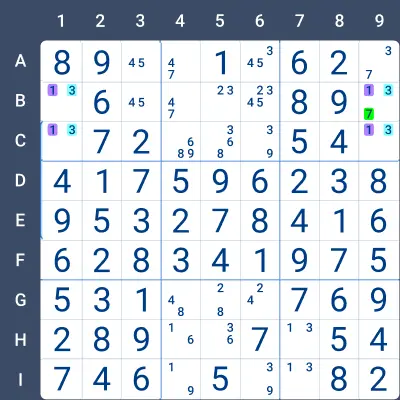
To apply the Unique Rectangle strategy, a potential deadly pattern must exist. In the image below, the deadly pattern involves cells B1, C1, B9, and C9. The digits 1 and 3 appear in two boxes, two columns, and two rows. In Unique Rectangle V1, only one of the cells in the deadly pattern has an additional candidate (B9 has the candidate 7), while the other three cells have only the digits 1 and 3.
If B9 ≠ 7, we have a deadly pattern, resulting in two possible solutions:
- Solution 1: B1=1, C1=3, B9=3, C9=1
- Solution 2: B1=3, C1=1, B9=1, C9=3
Since the board must have a single unique solution, B9 must be 7.
Example 2
Unique Rectangle V2
In Unique Rectangle V2, multiple cells of the pattern have an additional candidate (X), and there are no other additional candidates in the pattern cells. The additional candidate X must be the solution to one of the pattern cells to avoid multiple solutions.
V2 Elimination:
Eliminate all candidates X from cells that see all the deadly pattern cells with candidate X.
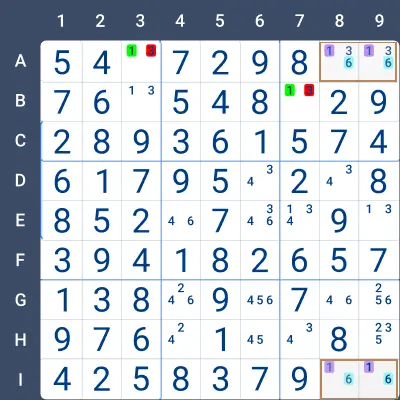
In the image below, the four shaded cells in rows A and I form a deadly pattern with digits 1 and 6. To avoid multiple solutions, 3 must be the solution for A8 or A9. Thus, we can eliminate all candidates of 3 from cells that see both A8 and A9. In this example, 3 is eliminated from A3 and B7.
Example 3
Unique Rectangle V3
In Unique Rectangle V3, a deadly pattern exists with two digits (X, Y). In one of the rows or columns, there are two additional candidates (W, Z). Either W or Z must be the solution to avoid multiple solutions.
Elimination:
If there is an additional cell (T) not part of the deadly pattern, and T has only W and Z as candidates, and this cell sees both W and Z in the pattern, then all instances of W and Z that see both can be eliminated.
Why is this true?
The pattern must have W or Z to avoid multiple solutions. Cell T has only W and Z as candidates, creating a scenario where two cells that see each other must contain W and Z. Therefore, every instance of W and Z that sees both cells can be eliminated.
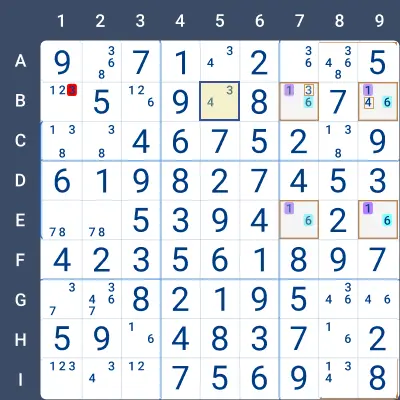
In the image below, the shaded cells in rows B and E form a deadly pattern with digits 1 and 6. The two cells in row B of the pattern have additional candidates 3 (B7) and 4 (B9). To avoid multiple solutions, either B7=3 or B9=4. Since cell B5 has only 3 and 4 as candidates, 3 and 4 must occupy cells B5, B7, or B9 in row B. Thus, any instance of 3 and 4 that sees all three cells B5, B7, and B9 can be eliminated. In this example, 3 is eliminated from B1.
Practise this strategy with built-in step-by-step hints inside our apps.