X-Cycles
expertX-Cycle is a tough and powerful solving strategy that uses chaining on a single digit to eliminate candidates. It is a closed chain (Cycle) where each node in the chain is used exactly once. The cycle alternates between Strong Links and Weak Links, allowing for smart decisions that would be impossible due to the weak links. A Strong Link can count as a weak link for alternation purposes. While an X-Cycle can include only Strong Links, strategies like Simple Coloring can handle cases with fewer than two weak links.
X-Cycle is a tough and powerful solving strategy that uses chaining on a single digit to eliminate candidates. It is a closed chain (Cycle) where each node in the chain is used exactly once. The cycle alternates between Strong Links and Weak Links, allowing for smart decisions that would be impossible due to the weak links. A Strong Link can count as a weak link for alternation purposes. While an X-Cycle can include only Strong Links, strategies like Simple Coloring can handle cases with fewer than two weak links.
Types of X-Cycles
1. PerfectCycle
A series of alternating strong and weak links that form a cycle. Each node in the cycle is part of both a strong and weak link. The cycle must have an even number of links. Elimination is off the cycle.
2. ImperfectCycleWithStrong (Type-I)
This cycle alternates between strong and weak links, except for one node, which is part of two Strong Links. The cycle must have an odd number of links. Elimination is on the cycle.
3. ImperfectCycleWithWeak (Type-II)
This cycle also alternates between strong and weak links, but one node is part of two Weak Links. The cycle must have an odd number of links. Elimination is on the cycle.
PerfectCycle Example
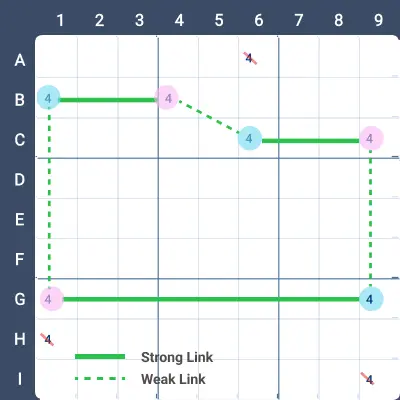
The image below shows a Perfect X-Cycle. Similar to Simple Coloring, one of the alternating colors must be the correct digit. In a Perfect Cycle, elimination occurs off the cycle, where digits that see both colors can be removed. An even number of nodes ensures perfect alternation of strong and weak links.
Why it is True:
Due to the presence of Weak Links, it’s crucial to start checking the digit from a specific point and move in a certain direction. Assuming the first end of the link is the digit allows decisions on the other end.
- Start from B1:
- B1=4 → G1≠4 → G9=4 → C9≠4 → C6=4 → B4≠4 → B1=4.
- B1≠4 → B4=4 → C6≠4 → C9=4 → G9≠4 → G1=4 → B1≠4.
In either direction, either the blue or pink 4’s must be true, eliminating all 4’s that see both colors. The 4’s marked with red stripes can be eliminated. This logic applies to cycles of any length. In fact, X-Wing is a Perfect X-Cycle.
ImperfectCycleWithStrong (Type-I)
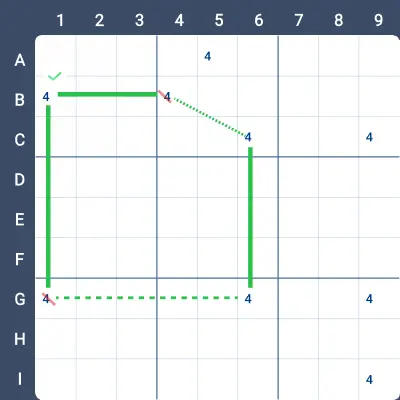
The image below depicts an Imperfect Cycle With Strong. Notice the alternating weak and strong links rotating clockwise from B4 to G1, with one node (B1) connected by two strong links. The cycle must have an odd number of nodes.
Why it is True:
If the node isn’t the digit, the other side of the strong link must be the digit. When the cycle is filled from the node with two strong links, a contradiction arises.
- Example:
- B1≠4 → B4=4 → C6≠4 → G6=4 → G1≠4 → B1=4.
This leads to a contradiction, proving B1 must be 4.
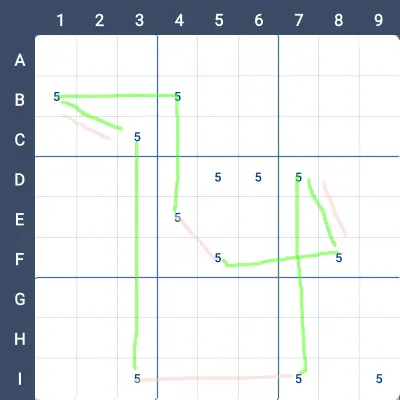
The image below is another example of Imperfect Cycle With Strong. It is added here to demonstrate how Strong Links can replace Weak Links. The link (B1, C3) is a strong, however it is in an alternating location of a weak link and can be treated as weak for the purpose of the alternation. The same goes for the link (D7,F8). Once we figure where the weak link should have been, we see that B4 is the node where 2 Strong Links meet and have to be the digit 5. We mentioned before the importance of the cell(node) where we start testing the digit. Try to make a smart decision on this X-Cycle from F5, try what happens if we assume that F5 = 5, and another time when F5 ≠ 5. Can you make a smart decision?…. the answer to this question at the end of this page.
ImperfectCycleWithWeak (Type-II)
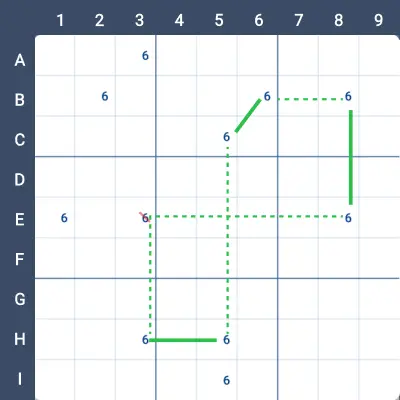
The image below shows an Imperfect Cycle With Weak. The cycle alternates between weak and strong links, closing with a weak link (E3→E8), creating a node (E3) with two weak links. The cycle must have an odd number of nodes.
Why it is True:
If the node is the digit, filling the digits through the cycle leads to a contradiction.
- Example:
- E3=6 → E8≠6 → B8=6 → B6≠6 → C5=6 → H5≠6 → H3=6 → E3≠6.
This contradiction proves E3 cannot be 6.
Clarification
Constructing an X-Cycle allows for decisions without identifying the specific cycle type by placing a digit and finding contradictions. Knowing the type helps avoid trial and error.
How to Find an X-Cycle
Start by drawing strong links for a promising digit, then check if you can connect these using weak links to form one of the discussed X-Cycle types.
Tip:
Look for a digit appearing in three cells across different groups of rows and columns. This digit is a strong candidate for the X-Cycle strategy.
Example 1: Perfect Cycle
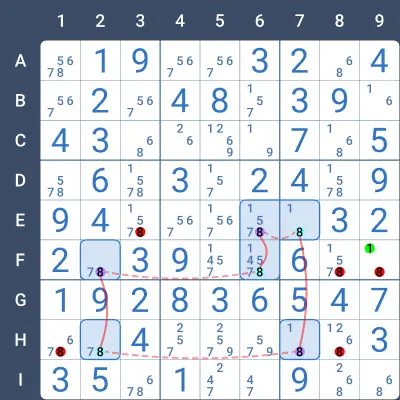
The image below shows a Perfect Cycle for digit 8. The cycle alternates strong and weak links, with six links total. Either the purple or blue 8’s must be correct, allowing the elimination of 8’s that see both colors.
Example 2: Imperfect Cycle With Strong (Type-I)
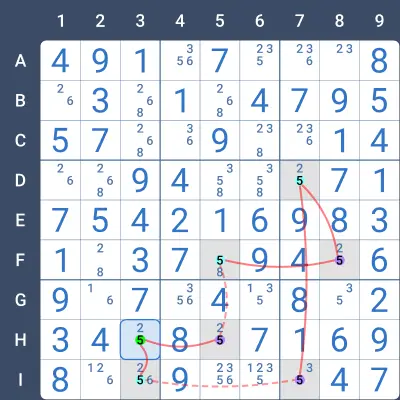
The image below depicts an Imperfect Cycle With Strong for digit 5. The cycle has an odd number of links, alternating between strong and weak. The node where two strong links meet (H3) must be 5.
Proof:
- H3≠5 → H5=5 → F5≠5 → F8=5 → D7≠5 → I7=5 → I3≠5 → H3=5.
This contradiction proves H3 must be 5. An additional X-Cycle could provide another decision.
Example 3: Imperfect Cycle With Weak (Type-II)
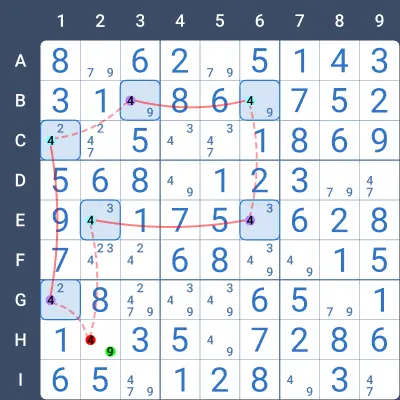
The image below shows an Imperfect Cycle With Weak for digit 4. The cycle has an odd number of nodes, with alternating links. The weak links (G1→H2) and (E2→H2) create two adjacent weak links meeting at H2, which cannot be 4.
Proof:
- H2=4 → G1≠4 → C1=4 → B3≠4 → B6=4 → E6≠4 → E2=4 → H2≠4.
This contradiction proves H2 cannot be 4.
Answer to the Question in Imperfect Cycle With Strong (Type-I) Section
Can you make a smart decision starting the X-Cycle from F5?
No, in both cases (F5=5 and F5≠5), we encounter situations where both sides of a Weak Link cannot have 5. This doesn’t contradict the definition of Weak Link and doesn’t allow for a decision or elimination.
Practise this strategy with built-in step-by-step hints inside our apps.