X-Sum
variantBoards with the X-Sum variant feature numbers positioned above and below the columns, as well as to the left and right of the rows. These numbers indicate the sum of the first X cells from that viewpoint, where X corresponds to the value of the first cell in that direction. For example, if the number above column 2 is 33, the first X cells in column 2 must sum up to 33, and the value of X is the solution for cell A2.
Boards with the X-Sum variant feature numbers positioned above and below the columns, as well as to the left and right of the rows. These numbers indicate the sum of the first X cells from that viewpoint, where X corresponds to the value of the first cell in that direction. For example, if the number above column 2 is 33, the first X cells in column 2 must sum up to 33, and the value of X is the solution for cell A2.
The X-Sum variant includes several strategies of varying difficulty to assist in solving puzzles.
The X-Sum strategies involve analyzing a column or row based on the numbers outside the grid and making decisions based on the clue, potential candidates for X (the first cell), and the solved numbers or candidates in other cells.
Tips:
- Identify potential digits for the first cell (X) of the X-Sum. These represent the possible lengths of combinations for the sum.
- A combination is valid for X-Sum only if one of the digits equals the number of digits in the combination.
- A sum of 45 corresponds to 1 + 2 + 3 + … + 9, meaning 9 must be in the first cell.
- A sum of 1 always implies that the first cell must be 1.
X-Sum Strategies
1. RemainingDigit
Level: Simple
If only one digit is missing to complete the X-Sum, find it by subtracting the total of the solved digits in the first X cells from the required X-Sum.
Example:
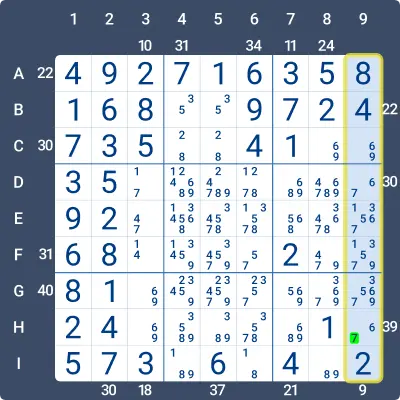
Observe Column 9 in the image below. The bottom X-Sum is 9. The digit in the first cell I9 (X) is 2. The sum of the first 2 cells in this column from the bottom must equal 9. Therefore, H9 = 9 - 2 = 7.
2. RemainingCombinations
Level: Advanced
Only combinations with exactly X digits are valid. Use these valid combinations to eliminate candidates and solve the X-Sum cells.
Example:
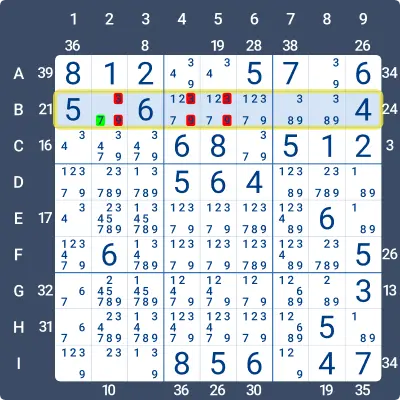
Look at Row 2 in the image below. The X from the left is 5. The sum of the first 5 cells from the left must be 21. B3 is 6 and must be part of the X-Sum. The 4 in B9 is outside the reach of X (5) and cannot be part of the X-Sum.
Digit combinations for 21: 1479, 2469, 2478, 3459, 3468, 12459, 12567, 13458, 23457, 123456
Combination elimination:
- Exclude combinations that are not 5 digits long.
- Exclude combinations including 4.
- Exclude combinations not including 6.
Remaining combinations for 21: 12567
3 and 9 do not appear in the remaining combination and can be eliminated from the first 5 cells of Row B. As a result, B2 is left with one candidate: 7.
3. X-Elimination-1
Level: Advanced
Using solved cells, eliminate possible combination lengths, allowing further candidate eliminations for X.
Example:
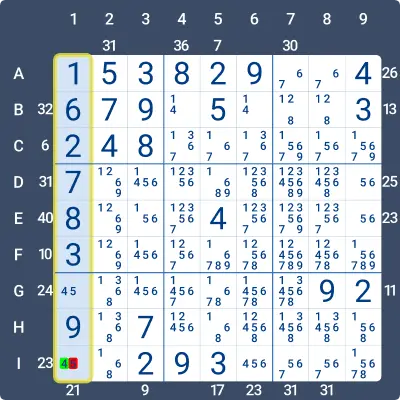
In the image below, the X-Sum in column 1 from the bottom is 21. If I1 = 5, the sum of the first five cells would be 29. Therefore, I1 must be 4, resulting in a sum of 21.
4. X-Elimination-2
Level: Advanced
Using solved cells and candidates, eliminate possible combination lengths, reducing candidates for X.
Example:
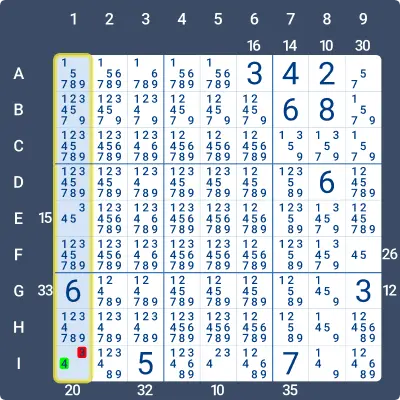
In the image below, the X-Sum in column 1 from the bottom is 21. If I1 = 3, the maximum sum of the first three cells would be 18 (3 + 9 + 6). Thus, 3 is eliminated from I1, leaving 4 as the only remaining candidate.
5. SmartElimination
Level: Advanced
Analyze all possible combinations and their digits to decide which digits to eliminate from multiple cells. Consider the X-Sum on both sides of a region, if applicable.
Example:
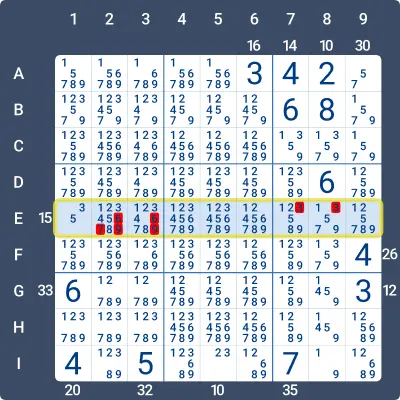
In Row E of the image below, the X-Sum is 15, with possible lengths of 3 or 5 cells.
Combinations for 15: 348, 357, 1248, 1347, 12345
After filtering combinations that are 3 or 5 cells long: 348, 357, 12345
Eliminations:
- All combinations include 3, so 3 is eliminated from E7 and E8 (outside the reach of 3 or 5 cells).
- Combinations do not include 6 or 9, so 6 and 9 are eliminated from E2 and E3. However, 6 and 9 cannot be eliminated from E4 and E5, as they could be valid if E1 is 3.
- Only one combination includes 7: 357. Since E3 does not have 5 as a candidate, 7 is eliminated from E2.
Practise this strategy with built-in step-by-step hints inside our apps.