XY-Chain
expertThe XY-Chain strategy links cells with pairs of candidates (bivalue cells) using strong links, assigning a different color to each candidate. The chain starts and ends with the same candidate (X) but in two different colors. Any candidate X that can see both ends of the chain can be eliminated.
XY Chain is an advanced solving strategy used to eliminate candidates from cells. In an XY Chain, each cell in the chain contains only two candidates, and neighboring cells share at least one candidate digit. The strategy is named for the two candidates (X and Y) in each cell of the chain. Both the first and last cells must contain the same digit (X). The chain is constructed so that X must be the solution for either the first or the last cell.
The two digits in each cell form a Strong Link, meaning if one digit is not the solution, the other must be. Neighboring cells in the chain form a Weak Link, meaning if one cell contains the solution digit, the other does not. Remember, every Strong Link is also a Weak Link.
The Elimination:
Eliminate all candidates of digit X that see the X in both the first and last cells of the chain.
How to Construct an XY Chain:
- Start with a chain of bi-candidate cells, beginning with a cell containing candidate X.
- Neighboring cells in the chain must see each other and share at least one candidate.
- Use two colors: assign each candidate in the first cell a different color, and alternate colors for candidates along the chain.
- The chain ends in a cell with X as a candidate, but with a different color than the X in the first cell.
- For an XY Chain to be useful, there must be cell(s) with candidate X that see both the starting and ending cells of the chain. The X in these cell(s) can be eliminated.
Let’s look at a few examples:
Example 1
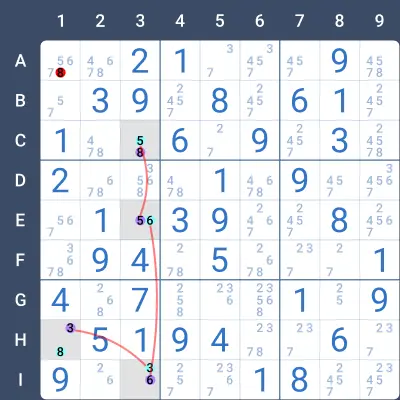
In the short XY Chain below, all cells in the chain are bi-valued. The first and last cells contain 8 as a candidate, but each has a different color. Notice the alternating colors along the chain. The cell A1 sees both the 8 in C3 and the 8 in H1, so 8 can be eliminated from A1.
Why is this true?
- If C3 = 8 → A1 ≠ 8.
- If C3 = 5 → E3 = 6 → I3 = 3 → H1 = 8 → A1 ≠ 8.
Regardless of the value in C3, A1 cannot be 8, as it sees a cell that must be 8. Notice that starting from either end of the chain would yield the same result.
Example 2:
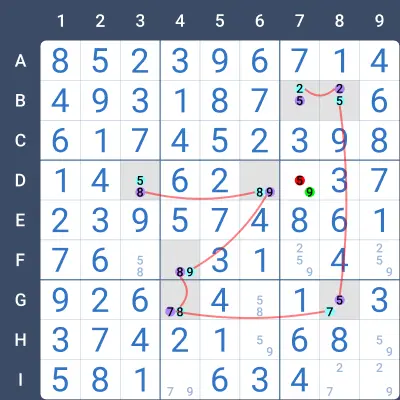
This XY Chain starts and ends with the digit 5. The 5 in the starting and ending cells have alternating colors. The 5 in D7 sees both 5s in the chain and can be eliminated.
Why is this true?
- If B7 = 5 → D7 ≠ 5.
- If B7 = 2 → B8 = 5 → G8 = 7 → G4 = 8 → F4 = 9 → D6 = 8 → D3 = 5 → D7 ≠ 5.
Again, regardless of the correct digit in B7, D7 cannot be 5.
Example 3:
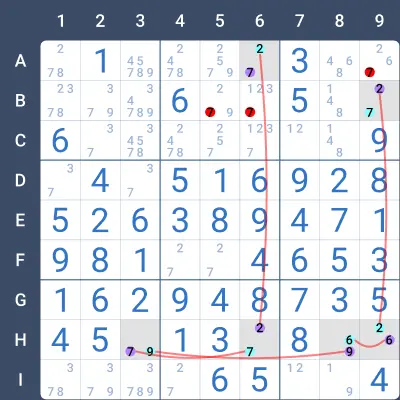
This XY Chain starts and ends with 7 at B9 and A6. Follow the chain and verify that you understand its construction and why the red 7s can be eliminated.
Practise this strategy with built-in step-by-step hints inside our apps.