XY-Wing
expertThe XY-Wing strategy involves three cells with 2 candidates each, forming a pattern where one cell (the pivot) shares a candidate with two others (the wings). If the pivot has candidates X and Y, and the wings have pairs XZ and YZ, the candidate Z can be eliminated from any cell that sees both wings.
XY-Wing is an effective strategy for eliminating candidates in Sudoku puzzles. Although considered advanced, it is relatively easy to spot. Sometimes referred to as Y-Wing, XY-Wing is a powerful tool for narrowing down possibilities.
What is XY-Wing?
- Involves three cells and three different digits.
- Each cell has two candidates from the three, distinct from the other two cells.
- One cell (the pivot) sees the other two cells (the wings).
- The two wing cells do not see each other.
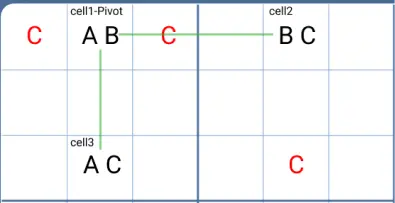
In the image below, cells 1, 2, and 3 form an XY-Wing. They contain three digits: A, B, and C. Each cell has two different candidates:
- Cell 1: A and B (pivot)
- Cell 2: B and C
- Cell 3: A and C
Cell 1 is the pivot, which sees both cells 2 and 3. Cells 2 and 3 do not see each other.
Once you spot an XY-Wing, you can eliminate the shared digit (digit C) from all cells that see both cells 2 and 3.
In the image below, cell 2 and cell 3 share digit C. We can eliminate C from all cells that see both cells 2 and 3 (highlighted in red).
Why is this true?
- If cell 1 is A, cell 3 must be C.
- If cell 1 is B, cell 2 must be C.
In either case, one of cells 2 or 3 must contain C, allowing us to eliminate C from all cells that see both cells 2 and 3.
Example 1
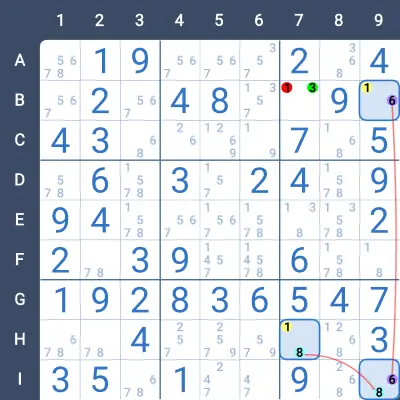
In the image below, cells B9, H7, and I9 form an XY-Wing, with I9 as the pivot. The three digits are 1, 6, and 8, with each cell containing a unique pair of these digits.
- I9 sees both B9 and H7.
- B9 and H7 do not see each other.
Digit 1 is common between B9 and H7, meaning one of these cells must contain 1.
- If I9 is 6, then B9 must be 1.
- If I9 is 8, then H7 must be 1.
Thus, we can eliminate 1 from any cell that sees both B9 and H7. In this case, we can eliminate 1 from B7.
Example 2
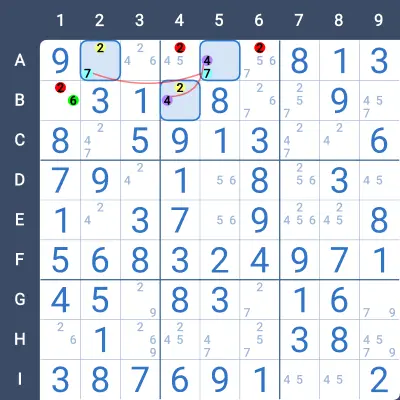
Cells A2, A5, and B4 form an XY-Wing, with A5 as the pivot. Either A2 or B4 must be 2. Therefore, we can eliminate 2 from all cells that see both A2 and B4 (highlighted in red).
Example 3
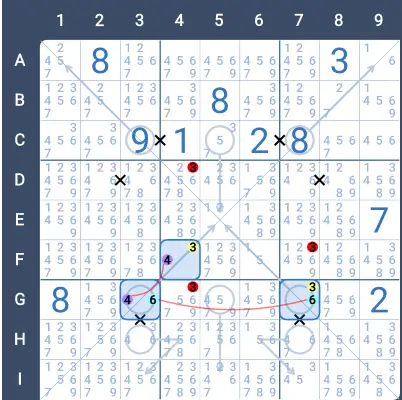
In this example, the board includes the Diagonal variant, where each main diagonal must contain all digits from 1 to 9.
Cells F4, G3, and G7 form an XY-Wing, with G3 as the pivot. F4 and G3 see each other due to the Diagonal rule. Digit 3 is common between F4 and G7, meaning one of these cells must contain 3. We can eliminate 3 from all cells that see both F4 and G7 (highlighted in red).
Practise this strategy with built-in step-by-step hints inside our apps.