XYZ-Wing
expertThe XYZ-Wing strategy involves three cells where:
XYZ-Wing is an extension of the XY-Wing strategy, used to eliminate candidates in Sudoku puzzles. It is sometimes referred to as the Bent Triple.
What is XYZ-Wing?
- Involves three cells and three different digits.
- One cell (the pivot) sees the other two cells (the wings) and contains all three digits as candidates.
- Each wing cell has two out of the three digits as candidates, with one digit common to both wings.
- The two wing cells do not see each other.
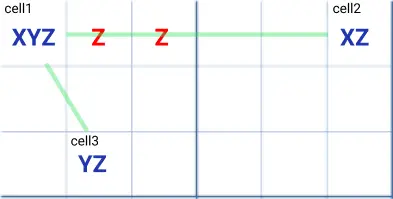
In the image below, cells 1, 2, and 3 form an XYZ-Wing. They contain three digits: X, Y, and Z.
- Cell 1 (the pivot) contains all three digits (X, Y, Z) and sees both Cell 2 and Cell 3.
- Cell 2 contains X and Z.
- Cell 3 contains Y and Z.
The digit Z is common to both wings. Cell 2 and Cell 3 do not see each other.
The Elimination
You can eliminate digit Z from all cells that see all three cells of the XYZ-Wing.
Why is this true?
Digit Z must be in one of the three cells:
- If Cell 1 is X, then Cell 2 must be Z.
- If Cell 1 is Y, then Cell 3 must be Z.
- If Cell 1 is Z, then Z is already accounted for.
Thus, Z must appear in one of the three cells, and can be eliminated from all cells that see all three.
In the image below, the red Z’s can be eliminated because they see all three cells.
Example 1
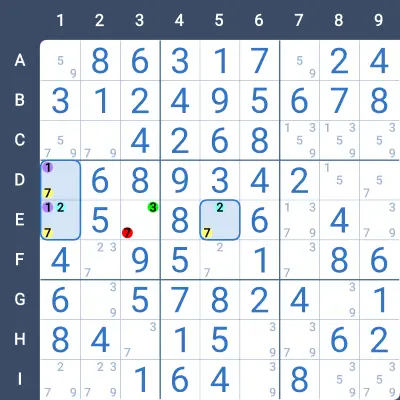
In the image below, D1, E1, and E5 form an XYZ-Wing with the digits 1, 2, and 7.
- E1 (the pivot) sees both D1 and E5 and contains all three digits.
- D1 and E5 each contain two of the three digits, with digit 7 being common to both.
- The wings do not see each other.
According to the XYZ-Wing strategy, digit 7 can be eliminated from any cell that sees D1, E1, and E5. In this case, we can eliminate 7 from E3.
Why?
- If E1 is 1, D1 must be 7.
- If E1 is 2, E5 must be 7.
- If E1 is 7, then 7 is in E1.
Therefore, 7 must appear in one of the three cells, and E3 cannot contain 7.
Example 2
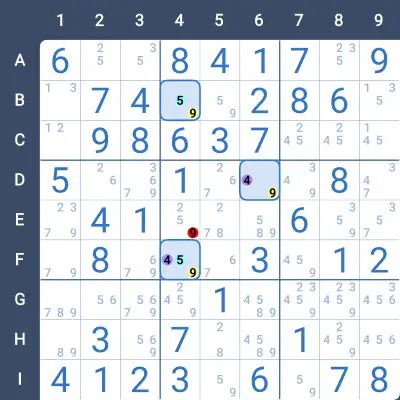
In this example, F1, D6, and B4 form an XYZ-Wing with the digits 4, 5, and 9. Verify that it meets the criteria for XYZ-Wing and observe why the 9 in E4 can be eliminated.
Example 3
This example extends the XYZ-Wing strategy into Sudoku variants, incorporating Classic Sudoku, Diagonal Sudoku, Chess Knight Sudoku, and Killer Sudoku. Only the first three rules are relevant here.
Chess Knight Rules: A digit cannot be within a chess knight’s move (two cells over and one cell across) from itself.
Diagonal Rules: Each digit 1 to 9 must appear only once on each of the two main diagonals.
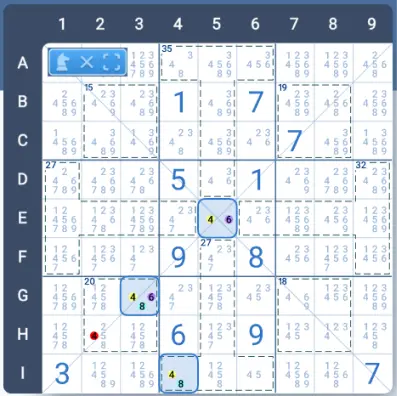
Cells G3, E5, and I4 form an XYZ-Wing with the digits 4, 6, and 8.
- G3 (the pivot) contains all three digits and sees both E5 and I4.
- G3 sees E5 due to the Diagonal rule.
- G3 sees I4 due to the Chess Knight rule.
Using the same logic, one of the three cells must contain digit 4. Therefore, 4 can be eliminated from all cells that see all three. H2 sees all three cells as it:
- Shares a box and diagonal with G3.
- Shares a diagonal with E5.
- Is within a chess knight’s move from I4.
Thus, 4 can be eliminated from H2.
Practise this strategy with built-in step-by-step hints inside our apps.